Tuesday, February 04, 2014

#Timelines - not invented here and, it is good


The best #software is used. The new timelines in #Reasonator are available and, it is wonderful. It is yet another way of showing of the data that exists in Wikidata. It is also one area where more data will lead to more interesting information.

This timeline software by the knight lab is open source and, even though it is great, there is room to make it even better. Just try it in Arabic. You would expect the data to go from left to right. It makes sense because the labels do show up in Arabic in the timeline.

What makes this implementation so nice is that all kinds of information relating to a person are included. The Reasonator reasons; it includes even the dates children are born.
Thanks,
      GerardM

#WDQ - the Wikidata #query is pumping

#Wikidata supports quantities. Consequently #Reasonator has to show available quantities. The obvious next step is: being able to query for quantities.

One of the obvious quantities people like to boast about is the number of cylinders in their motor. Obviously both the motors and their numbers of cylinders have to exist in Wikidata. At this moment there are only two engines with 14 cylinders known.


It is great to be able to find them. This is one kind of miracle. The other miracle is the Wikidata community; they will start pumping huge quantities of quantities in Wikidata. This will really have a big impact on Wikidata because the number of statements per item will mushroom. We live in interesting times.
Thanks,
       GerardM

#Reasonator - Albert's creeping zinnia


Compare the Reasonator page to the #Wikipedia article for Albert's creeping zinnia. There are a few extra features on each side. Obviously the Wikipedia article has more text. Reasonator features:

It is the picture that warrants special attention. Many of the species on Wikidata do not have a picture. Many of them do not have a picture on their Wikipedia article either.

To remedy this Magnus is running a bot looking for freely licensed pictures on Flickr. Such targeted actions do have results... lots of results. The only question is who is going to verify that they are indeed of the missing species.
Thanks,
        GerardM

Monday, February 03, 2014

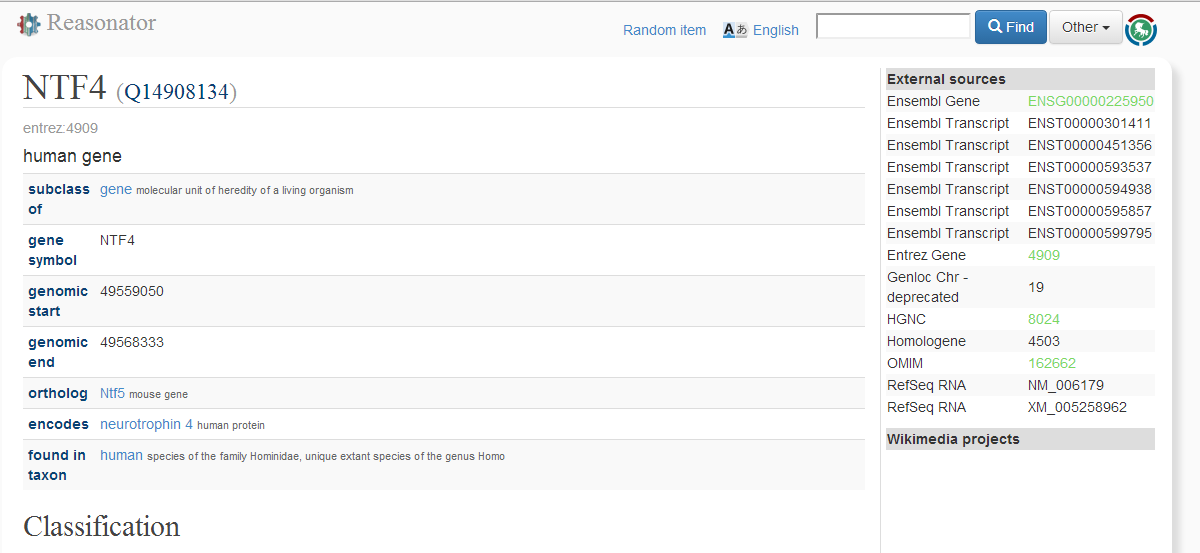
#Wikidata - NTF4; a human #gene


The aim of "sharing in the sum of all knowledge" is hard when there is no information about a given subject in any Wikipedia. It is therefore exciting to notice that information has been imported from an external source. For the NTF4 human gene the source is Entrez. Entrez being the source is well established as it is identified on the statements for NTF4.

As you can see in the screen shot, many other external resources have been identified as well. At the bottom you can still see that a classification is included. For some of the external resources it is known how to refer directly to that website, for others it is not obvious. When you do know, please let us know..
Thanks,
       GerardM

Sunday, February 02, 2014

#Wikidata - showing off deprecated & preferred values


The great news is, #Reasonator knows about ranking. It is however a functionality of Wikidata that still has to gain traction. At this time there are hardly any deprecated or preferred statements. For this reason the Sandbox is used to show off this latest functionality.

It is fairly obvious what is preferred... BIG letters... it is also obvious what is deprecated... the smallest letters..
Thanks,
      GerardM

#Wikidata - Ranking an #infantry battalion


Many infantry battalions have their Wikipedia article. Obviously an infantry battalion is a military unit and they are part of an army. There are categories with such battalions so it is relatively easy to add them to Wikidata.


Reasonator shows for infantry battalion, this is in effect a "subclass", really nice what the upper layers of the Wikidata ontology looks like. In effect it has become a tool to "walk the tree".
Thanks,
     GerardM

#Bots to the rescue

In #Wikidata, any item that does not have a label is of questionable value. According to the statistics, at the beginning of the year there were some 114,000 items without a label.

It is not a real problem as the name of an article can be used for a label. The most recent Wikidata statistics prove what bots can do. Currently there are some 9,000 items left without any label.

Some items have multiple links to Wikipedias and some of these links are without a label. These have also been updated. They are the real winners because these items are more likely to have statements. This is where all this effort truly adds value.
Thanks,
      GerardM

Friday, January 31, 2014

#DBpediaAmsterdam - a confererence update

Speaking about #Wikidata at the #DBpedia conference in Amsterdam was a joy and a privilege. It was a joy because there was a real interest even a practical interest in what can we do to make a difference.

These are some of the points that they found most relevant
  • Wikidata is used in templates in several Wikipedias
  • for DBpedia, the specific properties in use in Wikidata are mostly a mapping issue
  • having more properties in use than are on display in a Wikipedia is in Wikidata not an issue
  • Wikidata is language agnostic while DBpedia has projects concentrating on specific languages
The process of how Wikidata is filled with information by bots was discussed at length. What bots do is harvest information from a Wikipedia and update the relevant items in Wikidata. This process is exactly the same for the update of DBpedia. The innovation that DBpedia can bring is by adding one extra functionality; reporting on the differences found. Obviously this will include new statements but identifying where Wikidata and Wikipedia have differences is really relevant when we work on improving the quality of the information we provide.

The relation of GLAM and Wikidata was another topic that received attention. In one presentation, Abraham Jacob van der Aa was mentioned. I added several statements for Mr van der Aa and showed how it shows in multiple languages in the Reasonator. It is not unlikely that as a result the Koninklijke Bibliotheek may provide us with information on Dutch authors in addition to what is available in DBpedia. The prospect of the Commons / Wikidata integration was also discussed; the existing links from Wikidata to Commons were mentioned but the possibility to link to the "Creator" and "Institution" templates were appreciated as having relevance to current practices.

The DBpedia conference had multiple simultaneous sessions so it should be obvious that much more was discussed. It is also my update of a conference that dealt with so much more and where a really vibrant community showed off what issues they are dealing with.
Thanks,
      GerardM

#Wikidata - the day Pete Seeger was born


Recently Pete Seeger died. The day he was born is random enough to show you the latest improvement in #Reasonator. All kinds of persons and events are on display. Some do not have a label in Russian while others do not have a label in English. You may notice that the Paris Peace conference was under way..

You may even notice events, the death or birth of people that are missing. For these events, just add them in Wikidata and given the vagaries of replication, you may notice them a moment later. Technically, five queries are happening simultaneously. They may take some time when you experiment with longer periods. To do that you click on the calendar in the sidebar. To make the waiting time a bit more dynamic, a waiting bar has been added.

By showing you events that are deemed notable in any and all of our projects, Wikidata truly shares in the sum of all knowledge. Reasonator is happy to visualise the sum of all knowledge as we have it in Wikidata.
Thanks,
       GerardM

Wednesday, January 29, 2014

The #DBpedia experience


DBpedia has been a regular subject on this blog. It is the culmination of the work of many research projects and its data is based on what can be retrieved from Wikipedia. One of the results is that an impressive amount of resources know how to link to DBpedia.

Tomorrow there is a DBpedia conference in Amsterdam. One of the subjects is the future of DBpedia. As far as I am concerned, there is a bright future for the approach that made DBpedia a reality. A future that they will share with Wikidata. In the end, it is the Wikidata project could do with more cooperation.
Thanks,
      GerardM

Reasonator ... reasoning and automating


When you look at "random items" in the "Reasonator", you will get the odd category, templates etc. Typically they have a colon in their name. When such an item has no statements, Reasonator will give you the opportunity to identify them as categories, templates etc.

It makes use of the oAuth technology; you have to authorise Widar to make statements on your behalf. For as long as you are logged on to a WMF wiki you can identify such items with just one click.
Thanks,
       GerardM

#Wikidata – in #taxonomy a #publication is not a #source

In the taxonomy of species, there are several  components required to make a “valid” description for a taxon.  They are the “taxon name”, the author, and the publication. The publication itself has its own components, among them is the name of the publication and the date of publication. They map neatly to what Wikidata uses for sources. It is however not a source and it should not be treated as a source.

A source asserts that something is true. There can be many sources that make such assertions. What they all do in taxonomy is refer to the original publication. A publication includes the formal description of a taxon.  There are only two languages allowed for a formal description; they are Latin and English.

When publications are treated as sources, it is hard / not possible to distinguish them from other sources.  Consequently the data loses its relevance as the information that makes up a valid description becomes incomplete.
Thanks,
    GerardM

Tuesday, January 28, 2014

A bit selective, not random

When you are looking for “random items” in the "Reasonator", you want to see items that are of interest. For all kinds of reasons, Wikidata includes references to templates, categories, disambiguation pages and list articles. 

They do not have much to offer that is of a random interest.

For this reason are all such items filtered from the random results. Sadly many categories, templates, disambiguation pages and list articles are not marked as such. As it does not take much effort to add the relevant statements, we hope that in the future you will see them not as much as you will today.
Thanks,
      GerardM

Are you a living #scientist with a #Wikipedia article?

One of the results of including VIAF records in Wikipedia is that VIAF gained more traffic. You do know that your Wikipedia article attracts attention for you. What is relevant is that people can progress from your article to your publications.

In Wikidata we do support ORCID. It only takes you a moment to add your ORCID identifier and, if you feel good about it, for some of your colleagues as well. Several of my friends have their ORCID identifier included and.. this is how it looks for one of them in Reasonator.
Thanks,
      GerardM

#Taxonomy, where there is nothing ...


When you do a "Random item", you can hit a species out of a genus like the Neotrichoporoides. This is a genus that is the "parent taxon" to sixty species. On the Swedish Wikipedia they have a category with all sixty species.

In "Widar" we have the technology to add a statement for "parent taxon" to all those sixty items. For all these species, it is their next step up for "Reasonator" to show their taxonomy.
Thanks,
      GerardM

Monday, January 27, 2014

#Taxonomy? "It is complicated"

Taxonomy in Wikidata is .. "complicated" to be polite. Take this bird for instance.. When you follow all the indicated taxons upwards, it belongs both to the kingdom of the Animalia and the kingdom of the Metazoa.

There are many simple solutions to this problem. One is that you only follow what the "parent taxon" has to say. The other is indicating to the taxonomy nerds that their house is not in order.

It is probably safest for me to leave it to the boys.. In the mean time all these taxons are a reason for a good laugh.
Thanks,
      GerardM

#Wikidata - experience the lack of "statements per item"


Wikidata is a young project. It is growing fast. A high number of statements per item ensures that an item is well connected in this web of data. As you can see in the graph, most items are not well connected; they are relatively low in what information can be provided about them.

Typically the items people are most interested in are relatively well served but often incomplete. Mr Rutte for instance held more functions. Considering the rest of Wikidata, he is well served.


If you are interested in experiencing the lack of statements, you can clink on the "Random item" button in the Reasonator. While you are at it, you can make more connections in Wikidata.
Thanks,
       GerardM

#Reasonator - the need for speed

If Reasonator is to work well and has to continue to work well, it has to scale and be as efficient as possible. Magnus has done a lot of work recently to improve its responsiveness. As it is, it does get its data from elsewhere and it is all about efficiently handling requests for information.

These are three results of the recent improvement in performance. 
Johann Sebastian Bach (Q1339)Wikidata : 18 sec (no images, no related items)
Old Reasonator : 12 sec (14 with images)
New Reasonator : 6 sec (9 sec with images)
Mammillaria (Q311120)Wikidata : 5 sec (no images, no taxon tree, no related items)
Old Reasonator : 8 sec (11 with images)
New Reasonator : 7 sec (10 sec with many more images)
Cambridge (Q350)Wikidata : 7 sec (no images, no location tree, no maps, no related items)
Old Reasonator : 8 sec (9 with images)
New Reasonator : 7 sec (10 sec with many more images)
The data is retrieved from Wikidata using the available APIs. There are two ways to look at that; you either accept what you are given OR you know that WDQ is able to provide the same data but faster. WDQ is as you read on Magnus's blog all of Wikidata but running completely in memory. At start time it is only 868MB RAM in size.

Help is welcome to make Reasonator and WDQ scale and to improve its user experience. Its page view statistics indicate a bight future and therefore an urgent need to consider all of this. Things that are considered are:

  • using puppet for better management and multiplexing the services provided
  • fixing memory leaks
  • packaging WDQ and Reasonator
We expect that Wikidata will be able to cope with us in bringing the best information available to us.
Thanks,
      GerardM


Sunday, January 26, 2014

#Reasonator - Better #RtL #language support


Several more languages are now identified as "Right to Left" languages. Arabic, Urdu, Divehi, Persian and Hebrew are supported. We certainly missed a few languages. Let us know..

When you look at the information for Golda Meïr in your language, you are bound to find a big issue in the information that is provided. It is one of those things where decisions made in a Wikipedia context are problematic in Wikidata.
Thanks,
       GerardM

#Wikidata - the case for including #Scopus references


Scopus is "the largest abstract and citation database of peer-reviewed literature". It is used a lot. Recently a publication looked at the coverage of scientists in Wikipedia. The scientists that were considered, all have their Scopus identifier.

To facilitate follow-up research, it makes sense to include Scopus identifiers in Wikidata. It makes sense to add other identifiers as well. For instance ResearchGate identifiers are more friendly to people looking for information. It is not pay-walled.

I am not suggesting that every person identified in Scopus or ResearchGate is notable. The point is that references to external sources are useful and allow for more effective research.
Thanks,
         GerardM