Monday, March 05, 2012

#Sanskrit, sources and scripts

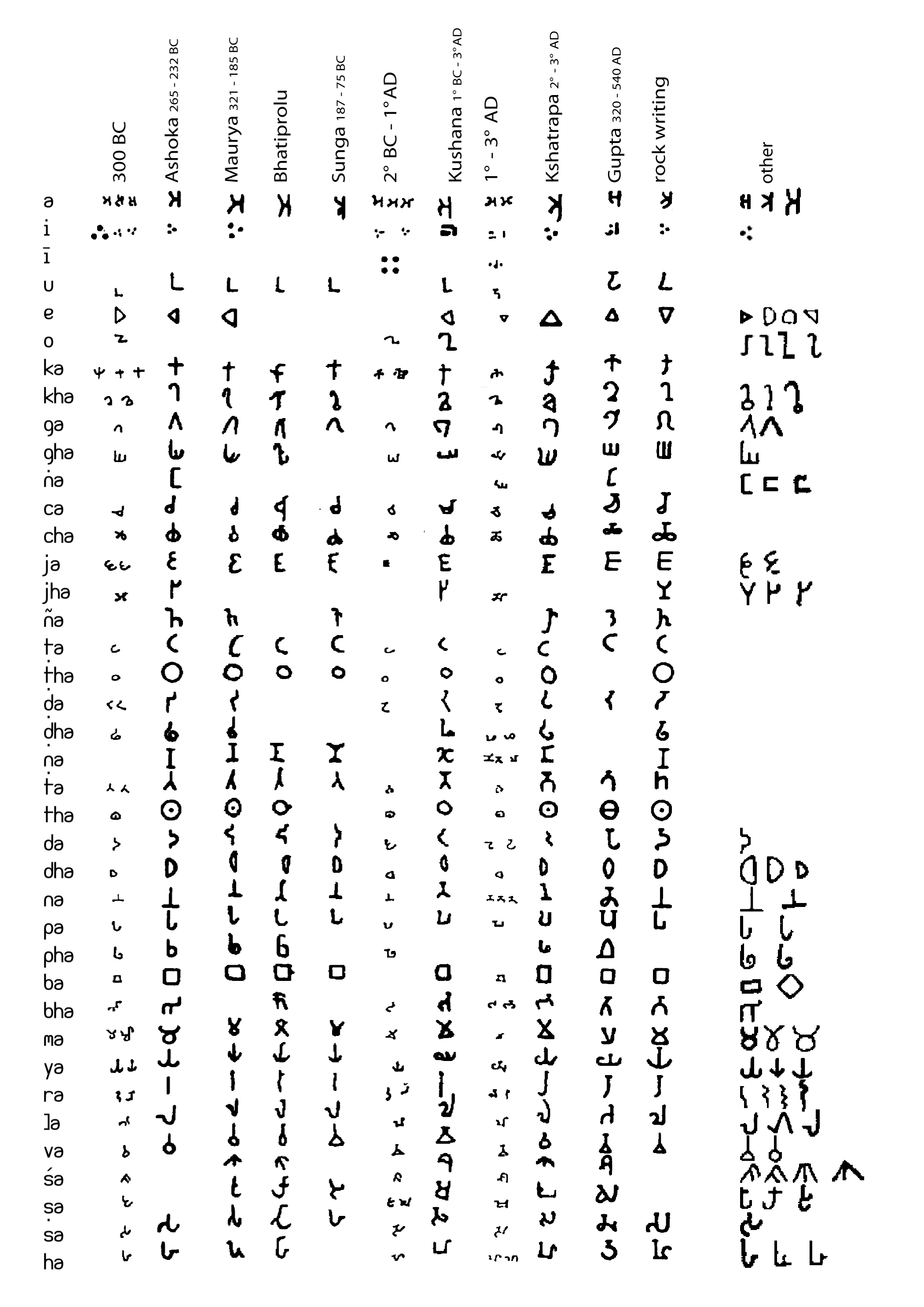
According to the English #Wikipedia, the Sanskrit language is written in Devanāgarī, various Brāhmī-based alphabets, and the Latin script. Practically we assume that Sanskrit is written in the Devanagari script and for its Wikipedia that is fine.

When Sanskrit sources exist in many scripts or alphabets, and particularly when the Brahmi based alphabets are not in common use, it is even more interesting for the Sanskrit community to find freely licensed fonts for these alphabets.
Asokan Edict - Delhi Inscription

The Omniglot website provides a lists of different scripts used for Sanskrit
Writing system used to write Sanskrit
Brāhmi, Devanāgari, Grantha, Kharoṣṭhi, Śāradā, Siddham, Thai, Tibetan 
Syllabic alphabets / abugidas 
Ahom, Balinese, Batak, Bengali, Brahmi, Buhid, Burmese, Chakma, Cham, Dehong Dai, Devanagari, Dhives Akuru, Ethiopic, Evēla Akuru, Gondi, Grantha, Gujarati, Gupta, Gurmukhi (Punjabi), Hanuno'o, Hmong, Javanese, Kannada, Kharosthi, Khmer, Lanna, Lao, Lepcha, Limbu, Lontara/Makasar, Malayalam, Manpuri, Modi, New Tai Lue, Oriya, Pallava, Phags-pa, Ranjana, Redjang, Shan, Sharda, Siddham, Sindhi, Sinhala, Sorang Sompeng, Sourashtra, Soyombo, Sundanese, Syloti Nagri, Tagalog, Tagbanwa, Takri, Tamil, Telugu, Thai, Tibetan, Tocharian, Varang Kshiti
It may be that it is not only a Brahmi font that will add more value to the Sanskrit Wikisource for original texts in Sanskrit. An original text is written in its original script and such a script may have different styles. It is great that with the WebFonts extension we can truly provide an authentic experience. It is just a matter of having the freely licensed fonts and an expressed demand.
Thanks,
     GerardM

Sunday, March 04, 2012

#Sanskrit #Wikisource will get WebFonts


Both the Sanskrit #Wikipedia and the Sanskrit Wikisource are written in the same language and the need for support for the language is the same.


As you can see, input methods are already available for the Sanskrit Wikisource and adding WebFonts on a Wikisource has much more potential. Historic texts were often written in a different style of the same script. With WebFonts it is possible to have multiple fonts available. When a specific font reflects the style at the time of a publication, it adds to an authentic experience.


One other fringe benefit is that text in a script that is supported by WebFonts can be indicated as being in the language and it will show up properly. We do not know of any Sanskrit sources including Cuneiform text but when there are, support for the Cuneiform web fonts can be invoked starting this Monday.
Thanks,
      GerardM

Saturday, March 03, 2012

Supporting a #font for #Arabic II

In January I wrote about the Amiri font. I wrote that it should be easy to support it in the MediaWiki WebFonts extension. This turned out to be not correct. One of the older more intractable bugs, one where Niklas prefers Brion to be involved in working on a solution, is preventing its use.

The Amiri font is as beautiful as ever and, we have implemented it in tranlatewiki.net as an experiment because the latest developments in the browsers' Unicode compliance is improving the rendering substantially. An Arabic text showing the Amiri font can be found here and the source looks like this:
<div lang="arb" class="mw-content-rtl" style="font-size: xx-large">
* بسم الله الرحمن الرحيم
* حررد مييسن
* مُحَمَّد‎
</div>
the Amiri font with the Firefox nightly build
Do note that in this example we use the ISO-639-3 arb code and not the ISO-639-1 ar code.

When you look at it with the nightly Firefox build it looks good. With production browsers the quality is still lacking. A MediaWiki solution will not only make a difference for the Amiri font, it will also make a difference for the Arabic font provided with Windows XP. Such a solution requires expertise in the inner workings of the MediaWiki parser and Unicode.
Thanks,
     GerardM

A logo for #Wikisource

The "official" logo for Wikisource is a bit funny. It is an iceberg about to keel over. It has been the logo used on most Wikisource projects and apparantly I am not the only one who does not like it.

According to the bug 33907, the plan is for the Marathi Wikisource to have its own logo. It is very much a logo for the Marathi Wikisource and it needs some adaptation when it is to be used for the Gujarati Wikisource.

What I would like is to have the logo for Wikisource revisited. The Marathi example is more obvious for a source project. It beats an iceberg that reminds people of the Titanic any day.
Thanks,
     GerardM

New templates for new #Wikimedia projects

People do request new languages on Meta. When a new language is requested, people will have to comply with a series of requirements. They are things like the localisation of messages, the writing of a few hundred articles that allow us to assess if what is written is really in that language..

When the requirements are met, when the members of the language committee are happy with the results, an e-mail is send to the chair of the board of the Wikimedia Foundation with the recommendation to approve the new project. Typically these recommendations are followed.

The next step in this workflow is the creation of a bug in bugzilla requesting the creation of the new Wiki. At that time specific technical information is needed. This information is needed by the Wikimedia engineers to create the project.


Robin made changes to the template and, we have changed the request for the Gujarati Wikisource. This request is in the final stage and we want to learn if the changes to the template make it easier to complete the necessary information.
Thanks,
      Gerard

Thursday, March 01, 2012

#Lohit fonts progress to #release 2.5.1

Thanks to the wonderful work by #RedHat engineers, the Lohit fonts will continue to be the preferred fonts for many languages of India in the MediaWiki WebFonts. When you read the announcement you can understand why:
Hi All,
 Announcing the Lohit fonts 2.5.1 release. Following are the highlights.
- Support for Characters added in Unicode 6.0 in Devanagari, Bengali, Malayalam and Oriya scripts and Devanagari Extended. 
- Release of Lohit Marathi and Nepali with language specific shapes.
 Please note here Lohit Devanagari has localize characters for Marathi
and Nepali with locl feature of Open Type fonts and one can access it
with specific LANG.
 Still we have released these fonts since some rendering engine (qt,
icu) still not supporting locl feature and second is user using en_US
locale can not access language specific characters from Lohit Devanagari.
- Releasing lohit-ttf tarball consisting all lohit fonts ttf
 This is for easy installation of all lohit fonts together. One can now
download it and simply copy all ttf fonts in required folder.
- Major bugfixes in Telugu, Kannada, Assamese, Punjabi.
 For further details see Changelog released with each language. 
I am working on Lohit Tamil fonts will release it soon with Lohit
Tamil Classical font.
The members of the WMF localisation team are really pleased; many of the issues we raised at our meeting in Pune have been dealt with. These issues became known to us because of the feedback of the people testing at translatewiki.net.

The 2.5.1 Lohit fonts are going to be installed at translatewiki.net for review in the next sprint.
Thanks,
      GerardM

Wednesday, February 29, 2012

#Twitter in Chinese or in Tamil; a different story

Twitter works well in English; 140 characters suffice. The objective of a tweet is to say something using only a few words. For some languages 140 characters provides a wealth of space (think Chinese) while other languages use many characters for a compound character (think Tamil) and it is hard to get the message out.

When you reserve space in a database for comments, the same logic applies. It may be an idea to configure the number of characters but the database itself should allow for a language like Tamil.

This is one aspect of internationalisation that is a bit deeper then making sure that characters are shown correctly. It is cool to see people who champion their language pick up on issues like this. Srikanth submitted bug 34586 and it is getting an adequate response.

Srikanth is part of the language support team for Tamil.
Thanks,
      GerardM

DYK #Wiktionary does #mobile

To my complete surprise, the "other" Wikimedia projects are now supported by the Wikipedia Mobile software. It is a bit of a hack because you may get a security message on some browsers stating "wikipedia" as the target with you having requesting your project in stead.

Having a menu on the English Wiktionary featuring "unflappable" as the word of the day is appropriate.

When there is no main page for your Wiki yet, you want to read the instructions on the creation of a mobile main page here. The tags available are very much appropriate for a Wikipedia but they can be used to suit your needs. Obviously for the best result you have to complete the localisation of the mobile application at translatewiki.net.
Thanks,
      GerardM

Have a #mobile, have a menu

When your #Wikipedia does not have a mobile main page yet, with some HTML trickery you can have one. One of the more recent projects to present a menu is the Kannada Wikipedia, I was also told that the Odia Wikipedia recently acquired a menu.

If you want to test if your project has a mobile main page, just include an m between the language code and the project code eg https://hi.m.wikipedia.org. When there is no mobile main page yet, you can find some instructions on the creation of a mobile main page here. Obviously for the best result you have to complete the localisation of the mobile application at translatewiki.net.

For languages like Odia and Kannada there is one additional bit of nuisance. It is the lack of support for the script used for the language in most browsers. It would be cool when the support of WebFonts is part of the mobile roadmap.
Thanks,
      GerardM

Tuesday, February 28, 2012

#Zulu is one of the 50 biggest languages

The Zulu language is spoken by many people so much so that it is one of the 50 most spoken languages in the world. You would assume that a Wikipedia in the Zulu language should be a thriving affair. Sadly, this is not the case. A request has been made for the Zulu Wikipedia to be closed.

The argument for closure is compelling: since the start in 2003 only 273 articles have been written and most activity is by bots, vandals and from people cleaning up the mess. A week ago I found someone willing to localise the Babel extension in Zulu but I am afraid that is as much as I can expect.

Good news is that the South African chapter has been registered. They are our local people on the ground. Some of them may speak Zulu and take pity on what is at the moment a failed project. Any subject needs articles any article needs improvement and yes, the localisation of the most used MediaWiki messages would be very welcome.
Thanks,
     GerardM

Monday, February 27, 2012

Cleaning up the #MediaWiki namespace II

Only those messages that need to be customised should exist locally. When many messages have only been localised like on the Assamese Wikipedia, the challenge is to copy the messages to translatewiki.net and once the LocalisationUpdate has done "its thing", remove the local messages.

Robin's tool does provide the necessary information about the messages that exist only on the local Wiki. For somebody who knows Assamese, the first step is a matter of copying the existing messages to translatewiki and verifying if they are correct. This improves support for the Assamese language on every Wiki.

Messages not localised at translatewiki.net
The job of deleting the local messages that are the same is something best left to a bot. It is best practice to remove them because it prevents problems down the line. A bot should perform this task on every WMF wiki.

Running Robin's tool is a task that should be run on any MediaWiki wiki. When this task has been performed on many wikis, there will be enough data to indicate the messages that typically have a local override. This could be the next step in optimising your local MediaWiki setup.
Thanks,
      GerardM

#Cuneiform is supported at #translatewiki.net

At the last #Wikimedia localisation team's Office hour, one of the questions was if we could support the cuneiform script. I blogged about it and we did find a font for the cuneiform script that was freely licensed. This font has been enabled at translatewiki.net.

When this font becomes available at for instance the English Wikisource, the text of the Epic of Gilgamesh or the Cyrus cylinder can be made available in the original format and we can be reasonably sure that any device that supports web fonts will show the characters as defined in the Akkadian font.

The Akkadian font is available in the Debian distribution and was developed by George Douros. There are several other fonts for historic texts created by Mr Douros. They can be made available. This however  will happen on request.

English Wikipedia without WebFont support
There is a point to making WebFonts available at this time. However, we will not push this functionality until we are done with a unified interface which integrates both input methods and web fonts. Currently the easiest way of identifying text in another language is using templates eg {{lang-nl|Dit is Nederlands}}.
Thanks,
      GerardM

Friday, February 24, 2012

Relevant historic texts


The Cyrus cylinder is arguably one important piece of world heritage. It consists of a text written in the cuneiform script. The text is still relevant after two thousand year so much so, that there is a TED presentation about it.


The text is in translation available at Wikisource. Given that the English Wikisource will support WebFonts next week, having a freely licensed font to do justice to the Cyrus cylinder is the next step before we can reliably show the text as it exists on the cylinder. Having a translation adds value to the source.
Thanks,
    GerardM

#Webfonts for an #English language wiki

When a project wants the #MediaWiki WebFonts extension they can ask and, the Localisation team is quite happy to provide and support it on an "as is" basis. Consequently as there is a request from the English Wikisource, we are really happy to grant their wish.

When you read the request, it becomes obvious what the purpose is for the web fonts; grammar books are mentioned; Gesenius' Hebrew Grammar, Grammar of the Burmese Language and Sanskrit Grammar and we do have fonts for these languages.

Obviously texts in the English language will not be affected. We do not support fonts for the Latin script yet but we could when it makes sense. The texts that are to be affected by WebFonts need to be identified as being in a specific language. For Hebrew it would be something like {{Lang-he}}. 


The Localisation team wants to have a better user interface to indicate texts in another language. This is when we expect to be ready to suggest enabling WebFonts on something like the English Wikipedia.
Thanks,
     GerardM

Cleaning up the #MediaWiki namespace

Your #Wikipedia may have many messages that can be safely deleted. Robin created just the tool to inform you what messages can be safely deleted because they are identical to the ones provided to you by MediaWiki.


These are identical messages on the Marathi Wikipedia that can be deleted because they are exactly the same. This is a job that any local admin can perform. It will make sure that when a message is changed, the updated message will become available. There is even a list that can be used to have a bot delete these messages; this may save someone from a lot of boring work.


Really interesting are the custom messages; they are the ones where the local message differs from the message provided by MediaWiki. They come in two flavours:
  • Messages that are correct on any Wiki and should be included at translatewiki.net
  • Messages that are specific to this Wiki
When the messages that are correct on any wiki are included at translatewiki.net, they will become available within a couple of days thanks to the LocalisationUpdate process. At that time these messages can be safely deleted.
Thanks,
      GerardM

Thursday, February 23, 2012

Trick #Android to use your language

When you are happily using your Android, it is still possible that it does not support the language that you are really using. As a consequence Android will in its standard configuration not enable you to indicate that you are using another language then the pre-configured ones. As a consequence it will not indicate in the meta data the correct language, languages like Neapolitan, Marathi or Frisian.

The "More locale" app allows you to add locales to your system. What I know is that you can add one with an ISO-639 code and you can specify a country code. particularly when your smart phone already supports the script associated with the language the result is wonderful. You can have Neapolitan or a Frisian enabled.

Given that the "Wikipedia mobile" app is localised in many languages that Android does not have as a standard locale, you may find that the "More locale" app will magically turn the localisation on in your language as well.

The screenshot you see to the right is taken on Amir's Android phone. His system has standard support for the Devanagari script and consequently it shows really well in our eyes. It is really relevant to check if a future phone supports you. Later versions of Android tend to do a better job.

Languages like Amharic, Gujarati and Malayalam do not have the same standard font support. For the scripts associated with these languages web fonts would be great but sadly we have not managed to make them work. Another option could be including fonts with our smartphone app. However tempting, it is much to be preferred when fonts can be included on the system level. Having the fonts is great when all you want to do is display texts, I am sure that people want to enter text in their language as well.

All in all, you can trick Android to use your language. The real challenge will be to enable the use of scripts that have no default support. Default support will make the "More locale" app redundant but until that time, it is very much recommended.
Thanks,
     GerardM

Wednesday, February 22, 2012

Why localise #MediaWiki at #translatewiki.net

Some of the localisations in use for MediaWiki need improvement. It can be for all kinds of reasons including bad grammar, typos, spelling errors but also because a message changed. When you are an administrator on a wiki, you can change such MediaWiki messages on your local wiki however, you should not.

When you improve a message locally, the result will be local and it will override the messages that come with the MediaWiki software. This includes the daily messages that are new or have been updated and come to you through the LocalisationUpdate process.

When you improve a message at translatewiki.net, you will find the experience much more productive compared to working on your local wiki. Tools are available to you that suggest translations, help you proofread what is already there. If anything, translatewiki.net exist to make you as a localiser as efficient as possible. You will find once you get going, you are at least ten times more productive.

For some people localising on-line is what prevents them from being productive. When the local connectivity to the servers of translatewiki.net leave a lot to be desired, it is sometimes better to work off-line.

Getting the message out why you should localise at translatewiki.net has its answer in this way. However, there is a reason why some messages need to be changed locally. It is because the message needs to be adapted to the local wiki. They may be about policies, contact information or whatever else is not standard. Only a few people need to bother with this and they are the local admins of a wiki, they are the ones who can change messages locally.
Thanks,
     GerardM

#Unicode #CLDR How to fix a wrong name

One of the languages in the Incubator is Mapudungun. It is spoken in Chile and Argentina and many of the Mapuche people are offended by the English name used for their language. The result is that they refuse to have anything to do with the effort to have a Wikipedia for their language.

The Wikipedia article on the Mapuche language mentions the name that should not be used and it states: "The latter was the name given to the Mapuche by the Spaniards but nowadays both the Mapuche and others avoid this usage". The question is; why does it say Araucanian, where does it come from and how can it be fixed.


MediaWiki uses the CLDR for such data and with some digging the record that has Araucanian can be found. The ISO-639 standard does not have it as its name so it can be changed. The next question is, who is going to do this. There are several issues:

  • the CLDR has only windows of opportunity when the data can be changed
  • actually changing things at the CLDR is an "experience"
  • we do not have anyone volunteering to join the language support team for English
  • we do need this change to be in the CLDR for this issue to go away
Thanks,
      GerardM

Tuesday, February 21, 2012

What will be the global benefit of using #Git for #MediaWiki

Git is a version control system. The Wikimedia Foundation is going to use it and frankly, I have no clue why. What I do understand is that the waving around of hands and the exclamation of buzz words looks good. I am not aware of the existence of a cost benefit analysis, something that would make things understandable.

My impression is that because of the introduction of git, the quality of the localisations and the internationalisations of MediaWiki and its extensions will be negatively impacted.

As it is, changes committed to Subversion, the current version control system, result in new messages in translatewiki.net within a day. These new messages become available to the twn community and as a result there is a steady stream of messages that need textual improvement and/or an explanation. As development progresses, the messages improve and the localisation is under way. At the time new functionality is ready for deployment it is localised in many languages.

With Git, there is no such thing as new messages that make their way to translatewiki.net. As I understand it this will only happen when the developer is done, the software is reviewed and is moved into "production" status. This means no internationalisation review, no textual improvements, no help texts and no localisations once software goes into production.

When a translator costs one hundredth part of a developer and we support three hundred languages then reducing the cost of development is not necessarily where we make our big wins. Our language support benefits from the current model and I fail to see why we should git going.

Really, what is the global benefit from using git over Subversion ?
Thanks,
      GerardM

Monday, February 20, 2012

International Mother Language Day 2012

#Wikipedia is without a doubt a good example of a multilingual project. On a good day we support 280+ languages. On a sad day there are more then 6000+ languages we do not yet support.

This year a lot has happened at the Wikimedia Foundation to support languages. As we now have a Localisation team, we support quite a few languages with web fonts and input methods. We are improving our translation capability. The internationalisation for our PHP and JavaScript code supports grammatical gender and plural.

Best of all is what we aim to achieve: we make editing MediaWiki as easy as it is to edit in English.

This year we will host an "office hour" at 18:00 UTC on IRC. The subject is very much how we can help you and how you can help us support your language. We welcome any suggestions that improves the use of MediaWiki in your language:

  • web fonts
  • input methods
  • translation
  • localisation
  • support for language rules for your language in MediaWiki
  • transliteration from script to script
  • your language support team
  • your suggestion....
Thanks,
      GerardM