Thursday, September 16, 2010

Rewarding the good work

the reward pathways in the brain
What answer do you give when someone asks: "What can the benefits be of me contributing to Wikipedia?"

The answer is always different but there are some common threads. When people ask for personal benefits, they want something tangible.

The power of publicly saying thank you is not to be underestimated. I thanked Besjana Osmenaj for the good work that she did and to my amazement I find it on Google as the sixth thing to her name.

When people study languages, they often become translators; they need to train there skills; translating with and without a translation memory based system. They will have to translate literally and localise it for an audience, they will need to learn the terminology for a particular subject matter. All this training can be done on Wikipedia articles. The reward is that for many languages it can result in their work being used and read.

A professional computer person may want to add MediaWiki as a platform that he supports. The LocalisationUpdate extension will help him improve the wikis in his language whenever people contribute at translatewiki.net. It is even an option to learn how to program MediaWiki or to learn internationalisation skills so that people seek out the professional for supporting localised software.

When people study and are learning a subject, their school or university may invite them to "spot the loonie" and correct and improve the subjects they are learning. It is a way of honing skills.

When we have a contest, we can provide the contestants with a certificate that explains the effort they put in and our gratitude for their contributions.

My point is that just saying "it" is fun does not work for everyone. Identifying skills that can be learned, skills that are valuable in real life may convince a person that there is more to it then a hobby for idle rich people.
Thanks,
      GerardM

PS there must be many more rewards, what would makes or made a difference for you ??

News from the language committee

Following the example of the science committee, we now have a logo as well. It consist of the outline of the Rosetta stone and some characters that can be found on the Wikipedia globe.

The best news is that after some internal discussions we have found a way to be more open about our deliberations. The big change is that the reason for our confidentiality has been largely taken away.


Our future mail exchanges will be published in the same way because when needed it will be possible to flag portions as confidential. This will be used sparingly and it will be to protect privacy when needed.
Thanks,
        GerardM

Wednesday, September 15, 2010

Holy cow

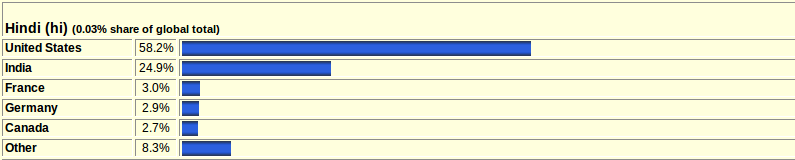
In #India the English language #Wikipedia is receiving the most readers. The "other" Wikipedias are doing significantly less. The statistics are clear about this.

Eugene Kim has published his first instalment of a four part series on the different challenges facing the Wikimedia movement. As developing traffic from India is a strategic goal of the Wikimedia Foundation,  and as Eugene has been so close to the strategy process it is relevant what he has to say.

China and India — India in particular — have extremely heterogeneous cultures, which complicates outreach. On the other hand, most Indians access and edit English Wikipedia as opposed to the native Indian dialects, such as Hindi. Increasing usage in India may require focusing on making English Wikipedia a more multicultural community as opposed to promoting the many Indic language Wikipedias.
pageview per country breakdown

Focusing on making the English Wikipedia a more multicultural community is an extremely good idea. This will not only serve India well, it will serve the whole world well. People do not know where to find places like Albania, Kerala or Tripura on a map so subjects about these places are easily considered to be hardly relevant.


What makes the text extremely problematic is the selection of words. The Hindi, Malayalam, Telugu and the many other Wikipedias are written in languages. Calling them dialects demonstrates a lack of awareness that is painful after all the time Eugene spent among us.


The suggestion that it may be necessary to make a choice between promoting the use of the English language Wikipedia versus promoting the Wikipedias in Indian languages is not only unnecessary it is also a very bad idea. It is a bad idea because the Indian cultures are very much intertwined with its languages.


Effectively supporting the Indian languages is something that is feasible for the Wikimedia Foundation. The benefits are clear; it will clearly demonstrate the sensitivity needed to perform well in India. It will generate a lot of free publicity and goodwill and it will help us reach out to the disadvantaged and under represented communities.
Thanks,
      GerardM

Six more weeks

Now that the Usability Initiative software has been rolled out to all the #Wikimedia Foundation's projects it is close to that time when it makes sense to reassess the most often used messages.

The most often used messages are selected because they truly are seen most often by our users. This makes it a reasonable requirement for them to be localised before a new language gets its first project. It has been more then a year and half since this list was last updated and with the introduction of the Usability Initiative software we expect that the composition of the messages will change significantly.

The messages at translatewiki.net will remain the same for some five, six more weeks. The language committee is happy to assess if all the requirements are met in that time. Once the messages have changed, it will be the new list that is used to assess if the requirements are met.
Thanks,
        GerardM

'Cause we are small and they are big..

When you go to a conference, a #t-shirt is often presented as a sign of appreciation for coming. For the "Free Software in Balkans 2010" conference, the “Ismail Qemali” University of Vlora outdid itself by presenting us with beautiful polo shirts with the name of the conference at the back and the logo of the university at the front.

Besjana Osmenaj who proved a great host and organiser
on behalf of the university of Vlora 

In Albania, the men are men and the women are beautiful. Both come in two sizes; small and medium. Most of the speakers who came to Albania, were XL or as in my case XXL this made fitting in the school banks a bit awkward.


The conference itself was stellar. Great speakers covering everything from the GNU make tools, the Autocad file formats, UNIX history and even Wiki promotion and localisation. For me it was a privilege to come to Albania and I want to thank for the friendly hospitality we received.
Thanks,
      GerardM

Tuesday, September 14, 2010

Gna-gna

The best #GNASH logo
When a conference like the "Free Software in Balkans 2010" conference has people attending like Rob Savoye, Peter Salus, or Leon Shiman you can be sure of some of the best presentations possible. They know things, they have lived in interesting times and they are people that mattered and matter.

Rob Savoye is well known for his current work on Gnash, this is a Free Software implementation and then some of Adobe Flash.

among other things, Gnash maintainer Rob Savoye

As translatewiki.net was also enjoying the proceedings, the talks and the networking an obvious subject was the localisation of Gnash. The current practice is that people send in a .po file to Rob. They are welcomed and they are added.

When the subject of Flash support for MediaWiki is mentioned, invariably Gnash is mentioned as a Free substitute together with the great amount of  educational software that relies on Flash. Anticipating a positive outcome of such (technical) discussions, there will be a need to support the hundreds of languages we support and we might as well consider supporting Gnash.

With Rob Savoye involved in the internationalisation and localisation of Gnash, we may even have a foot in the door and improve on the Gettext functionality. As Niklas has indicated on translatewiki, there is a need for consistency for things like the plural rules. We are already looking for verification particularly for plural functionality of what is correct. We hope this will result in harmonised CLDR, MediaWiki and Gettext support.

The Vlora conference may lead to the localisation of Gnash at translatewiki.net, it may lead to improved internationalisation support and we hope it will also bring the moment closer where Flash content is supported in the Wikimedia Foundation's projects.

For me the Free Software in Balkans conference proved a really relevant conference... (to be continued)
Thanks,
      GerardM

Monday, September 13, 2010

Pin the tail on the donkey

#Vlora #Albania was the scene of the "Free Software in Balkans 2010" Conference. I had the privilege and honour to be asked to present about Wikipedia. The Albanian Wikipedia can use many enthusiastic new editors and with a request for a Wikipedia in Gheg waiting to happen, I created a presentation about how to create a fun Wikipedia that actually gets a lot of traffic.

Vlora free software in the Balkans
View more presentations from Gerard Meijssen.

In the mean time there was this thing, Flora and Albania would I be able to find it on the map? Would the average person shopping on the Almere market be able to find it?

Thank you Sue, Kim and Casey for your inspiration

Are you able to find Albania on a map let alone Vlora? This question I asked my public and, I invited them to help us by producing many pictures for Commons and articles on our many Wikipedias.

Vlora is a relevant town, there should be encyclopaedic articles on it and its history. I will write some more about the conference in the days to come because many of the people were just amazing.
Thanks,
       GerardM

Wednesday, September 08, 2010

Which language will be the next to be supported by #StatusNet II

The next release of the StatusNet software 0.95 will be at the end of this week. So if you want to make a difference for your language, there is tonight and tomorrow until Brion and Siebrand are ready for it.

Thanks,
       GerardM

Community vs planned software development

#MediaWiki development is of interest to many people. There are people who hack the functionality they need and there are people who work for an organisation. An organisation that may be the Wikimedia Foundation, but more people work for other organisations.

When Wikipedia was young, things were simpler. Everybody volunteered. There was less code, there were fewer systems and there was less traffic. MediaWiki is truly open source so you could still scratch your own itch and it was likely for the new or changed functionality to go live.
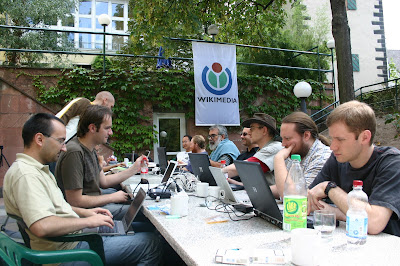
Hacking days in 2005

Then things started to scale. Wikipedia traffic grew exponentially, more servers were installed in multiple locations, down time became less acceptable, security became vitally important and the number of projects that needed support did not stop growing. To scale support, Brion and Tim were the first hired to do what they did best. After that they stopped scaling and that became really obvious because many issues refused to go away as the work left to do did not stop scaling.

Dilbert.com

Working with the community of developers was high on the list of priorities. As a result the ability to run "big projects" became complicated. As grants were accepted promising results in a set time frame and Brion left for StatusNet things reversed and it became more difficult for community developers to get their code assessed.

The office 2010

My own experience with extensions like the LocalisationUpdate may help to understand. The software worked fine but it was not optimal for the WMF as it updated one wiki at a time. Making it more efficient gobbled up time from several developers before it worked satisfactory. LocalisationUpdate proved itself because since its implementation the motivation of the localisers at translatewiki.net led to improved language support. Other extensions like the Babel extension and the Translate extension are still waiting for a keen eye that may make them WMF ready, both are translatewiki.net ready :)


As Brion was so crucial and did not scale and left for pastures green, a different, scalable approach had to be found. His job was split into pieces and first Danese was hired as a CTO. It is now her job to build an organisation that will do all the things Brion worked at and make it scale too. As the organisation did not stop growing and as there are plenty of projects making their way towards production it is not a sinecure.


At the same time people are clamouring for improved language support; this will enable people to edit Wikipedia and make it fun too; this will motivate them..
Thanks,
        GerardM

Monday, September 06, 2010

Motivating is best done by making it fun

Research shows that the top motivation for contributing to Wikipedia are motivation and fun. Fun is the biggest motivator but as importantly, only fun has the potential to increase contributions.

The good news is what motivates us, bringing free knowledge to every man, woman and child does not stand in the way of having fun. The use of free software does not stand in the way of having fun.

So lets have more fun.

What can we do to make Wikipedia more fun. We can provide the kind of data that is meaningful to individuals like how much their articles are read. We can make communication among us easier. There is so much we can do and have fun.

Making things more fun will have us weigh secondary priorities differently. We will still need reliable servers and backups, great usability. We will still aim to double our reach as it is one of our strategic goals and you know, we are not the only ones for whom fun is important. It is one of the reasons why Wikia for instance is doing so well..
Thanks,
      GerardM

The anti #Wikimania tradition, and other respectable traditions

It has become a tradition to find fault with the next venue of Wikimania. Too far, politics, gender issues, you name it the arguments you can think off they have been used.

With the next Wikimania in Haifa, it is again after the next venue has been announced, the contracts have been signed that people find fault. There is a Facebook thingie protesting against it. I guess that the people behind it know that the normal channels have not given them their satisfaction and use Facebook to vent their frustration that they feel they cannot come.

Apart from dealing with frustration, there is not much to be achieved. There are people who are prevented from coming by their government. The only way to deal with that is by having a future Wikimania in for instance Tehran or Damascus .. I would however prefer Djakarta or Algiers as it is easier on the WMF, it being an USAmerican organisation..

People who oppose forget how a venue is selected and what Wikimania is about. The candidates select themselves, the volunteers in a country, a chapter spend an inordinate amount of time to get all the details like venue, budget etc right. Another group of volunteers assess the bids by the candidates, they organise public sessions on IRC where the bids are presented and any and all issues are discussed.

Wikimania is the yearly event where any and all issues can be presented to a worldwide audience. Many people who come are regulars, many people are new and many people are local or near local. For the organising community it is a massive shot in the arm, the benefits to the editors and readers are great.

Every Wikimania has its special things, every Wikimania has its issues. Wikimania has its traditions, one of them is its troll. We do not need Facebook or other websites for that..
Thanks,
      GerardM

Sunday, September 05, 2010

#Jmol - a paradigm shift in crystallographic visualization

Jmol provides state of the art visualisation of chemical structures. With the publication of Jmol - a paradigm shift in crystallographic visualization in Applied crystallography online, Robert Hanson argues how current technology provides unprecedented opportunities to teach about symmetry, uncertainty and the overall enterprise of molecular structure determination.

A portion of a DNA-protein complex - Toggle it !!
By just browsing the paper, you find many illustrations that show chemical structures that rotate, that can be toggled, that leave no doubt that chemicals are three dimensional. There have been many people who have argued that something like Jmol would be a worthwhile addition to Wikipedia. There is an extension that works and that is still waiting for some TLC so that it will be safe and fast enough. It will be the moment when the many existing Jmol generated illustrations in Wikipedia can be replaced by the real stuff.
Thanks,
     GerardM

#Unicode has 50% of the web traffic

With all the websites relevant to me in Unicode, it is a surprise when I learned that in is only from this August 50% of web traffic is in the Unicode encoding.

Google January 2010

The growth has come particularly from a decrease in the use of older encoding systems used for Western languages. The graph also helps understand why many of the scripts like Devanagari who have had relatively recent changes in the Unicode definitions have so much room for growth. This also gives the impression that people do not have the Unicode fonts that MediaWiki relies on.
Thanks,
     GerardM

Which language will be the next to be supported by #StatusNet

At translatewiki.net there are agreed levels when a language will be committed to the code repositories. For StatusNet this agreed level is 35%. The Georgian language was committed today, it is currently at 50.83% and consequently the user interface of identi.ca will be available once the 0.95 release goes life.


There are many more languages that just require that extra bit of effort. Maybe your language is among them.
Thanks,
      GerardM

Google #Translate for #Wikipedia please

Jean-Baptiste Noulet is credited as a pioneer of the study of human fossils of the prehistory. As Mr Noulet is French and it was in Toulouse where a gallery was opened in 1872 dedicated to finds from the prehistory. In 1882 a university chair was created dedicated to the study of the prehistory.

There is nothing to learn on the English Wikipedia on Mr Noulet. There is on the French Wikipedia and because of an exchange of e-mails on the subject of collaboration of the French chapter with GLAMs, I needed to learn more. I used Google translate by copying and pasting the text.

For the people who have difficulties reading my blog, I provide Google translate as a service. I would love Wikipedia to provide the same service.
Thanks,
      GerardM

Friday, September 03, 2010

A university outreach project for $ 14,933,-

The "Bebaskan Pengetahuan 2010" competition has come and gone. Ninety participants of 10 universities of the greater Jakarta area competed for the chance to go to Wikimania in Gdansk.

The project is done, Kartika Henry is back from Poland and the reporting on the project is amazing. It really makes me wonder what could be done with a budget of $149,333,-- in Indonesia. It would be money well spend, it would change the face of the Indonesian Wikipedia and it would grow the number of articles, the number of frequent editors and the traffic of the Indonesian Wikipedia dramatically.
Thanks,
      GerardM

Thursday, September 02, 2010

The North Frisian #Wikipedia is accounted for

The "Monthly Page Views" shows for all Wikipedias show how much traffic they have generated. It is always a happy moment when a new Wikipedia makes its first appearance.

The month is young, it will take some time for it to settle it its proper spot.
Thanks,
       GerardM

About openness and transparancy

CafePress.co.uk
It is annoying when other people tell you what to do. It is even worse when they do not listen to the arguments why things became in a certain way.

My communications to the Language committee are not open for public scrutiny. That is not that special as there are many WMF communications that are confidential.

One conversation with a person subscribed to the internal-l told me: "it is common practice to post on foundation-l when the subject does not need to be confidential and, that it should be posted to foundation-l as well".

This practice is flawed because of a number of people who refuse to enlist to the foundation-l. The consequences are twofold. First of all things do not get posted to foundation-l and secondly, their contributions are kept secret without a reason.

To me it is obvious that nothing will change. But the people who are on internal and not on the foundation list and bitch can buy me the t-shirt.. I prefer one in the XXL size.
Thanks,
       GerardM

#W3C: Two or three-letter language codes?

The W3C answers this question for us in a recently published Q&A. There is a bit of "background" in it and, for me it is a bit sparse AND it misses a few important points.

The ISO-639-2 did indeed introduce three-letter codes but it was functionally awkward. It was in effect two codes. With the arrival of the ISO-639-3 the number of languages was importantly extended and concepts like macro languages were added. With this standard it became realistically possible for many languages to make their appearance on the Interneet.

The answer to the question? Both.
Thanks,
     GerardM

#Dilbert and restricting access to problematic texts

who can claim copyright
The Dutch National Archive is busy digitising newspapers. They make them available on the Internet. For most newspapers this is not that controversial. These newspapers are a sign of the times, they reflect the opinions that were prevalent in those days. For some newspaper it can be controversial.

Dilbert, September 2 2010
Before and during the second world war, the NSB was the Dutch Nazi party. There were NSB newspapers before the war and during the war who made propaganda for a nazi and fascist ideology. As the National Archive received a large subsidy to digitise the heritage of the war, and as a scientific advisory committee selected the "wrong" newspapers as well these NSB newspapers will be digitised as well.

The Dutch justice system warned the National Archive about the legality of publishing the NSB papers. As a consequence many pundits gave their opinion. In the end it is agreed by most that the National Archive allows people to do a faithful study of the period only because these newspapers are published.

The nazis and fascists will indeed be able to find these sources but they are there also for everybody else. Given that they prefer to quote out of context, the publication may even be a blessing in disguise for those who fight fascist propaganda.
Thanks,
       GerardM

For more information see the Q&A of the National Archive about this issue (in Dutch).