Showing posts with label Fonts. Show all posts

Monday, February 17, 2014

The place of #language support in #MediaWiki support

At this moment #Wikipedia has 280+ versions. They represent 280+ different languages. Every language is written in a script. This script may be from right to left (eg Latin), from left to right (eg Arabic). Top down is not yet supported.

All these languages use Unicode to represent the characters in their script. As a consequence it is "just" a matter of configuring a language correctly and it will work in a wiki. The characters used in a script have to be defined in Unicode. Without this supporting a language is problematic. An example of this is the SignWriting script and all the sign languages. They are not supported by the Wikimedia Foundation and they are developing their software themselves.

When people want to have their own Wikipedia, they have to localise the MediaWiki software at translatewiki.net. This is a requirement for the people that request a new project to fulfil. All that is required to support another language is some configuration.  To support all languages other than English, MediaWiki developers have to internationalise their software. This is a well established process, there is nothing special in there for "small languages", it is the same process for any language.

When people use MediaWiki it can be assumed that they use any of these 280+ languages. It cannot be assumed that they know any other language than their own. The Universal Language Selector allows people to select the language they need for their user interface. They can choose a language by typing in the name of their language in their own language.

Once a languages is selected, MediaWiki supports both input methods and web fonts. This is necessary because most devices do not support all the languages MediaWiki supports. At this point a user can read and write in MediaWiki. A special case is the OpenDyslexic font; is enables 7% of a population to read their language with less effort. This font works only for many languages that are written in the Latin script like English.

One other aspect of language support is in enabling search in all the 280+ languages. This is where Wikimedia engineers may have to do special things for a single language. When they do this well, they only have to do this once. Typically however, setting up search for a language is well documented, it is part of international standards.

Language support for MediaWiki is nothing but internationalising the software and for being mindful that MediaWiki is used by people representing over 300 cultures and languages. There is no special consideration for small or big languages.
Thanks,
        GerardM

Monday, December 09, 2013

The best #Sinterklaas #gift ever

One type of gifts at a Sinterklaas party are the #surprises. They may come with a rhyme, with special packaging and some surprises are beyond special, they are personal; they have an impact. The wife of my nephew is an emergency ward physician. Well educated, highly trained, with great bed site manners, all in all a lovely lady.

She explained when the topic turned to writing, why for her writing in the same way as her husband who writes professionally is impossible. The conversation moved in the direction of reading and how hard it is for her. Differentiating between "rr" "m" and "nn" is hard; it takes two three tries to know for sure what word is in front of her.

This sounded like dyslexia and, I asked her to have a look at Wikipedia with the OpenDyslexic font enabled. This was an eye opener for her. Every word showed itself the first time. Reading was not the big effort it usually is.

The OpenDyslexic font is a free font. It is easy to download. You can use it in Windows, Linux or MacOS. It can be used with Chrome and Firefox. You can select it in many Wikipedias.

For me the surprise was in learning how much of a struggle it was for her to learn to read. My respect for her has grown considerably. Learning first hand how much of a difference a different font makes is different from knowing this intellectually.

The configuration of language settings is well hidden on a Wikipedia page. My concern is how dyslexic people will find the functionality that is there to help them.
Thanks,
       GerardM

Wednesday, November 14, 2012

A #font for people with #dyslexia III

Yesterday I met a teacher. I also met someone who was a counselor in Mali. She was really enthusiastic about the news that there is a freely licensed font that works especially well for people who suffer from dyslexia.

Today I received a mail where I was told that the availability of the Open-Dyslexic font will be the basis of a possible project in Mali.
Thanks,
      GerardM

A #font for people with #dyslexia

Today I was able to make some difference. I met a teacher who is specialised in children with "special needs". The conversation got onto the subject of language technology and I mentioned the existence of the Open-Dyslexic font.

She was so happy to learn about the existence of this font. She asked me to send details today so that she can install the font on her pc tomorrow. This week she is going to meet some thirty persons who will be happy to learn about the existence of this freely licensed font as well. A lot of children are going to benefit.

I cannot wait for the Wikimedia Foundation to make the Open-Dyslexic font available for use on its wikis. It will affect so many more people. It is likely to be mentioned in the international press; it is that relevant.
Thanks,
       GerardM


Monday, June 18, 2012

#Batak - getting a #script ready for the #Internet

Several languages from Sumatra, #Indonesia were originally written in the Batak script. This script was encoded in Unicode and the waiting was for a freely licensed font. Thanks to a grant by the Wikimedia Foundation, a project is under way that will produce a font for Batak and will transcribe sources from Dutch museums like the Tropenmuseum.

For a script to be encoded into Unicode, a lot of research goes into describing the font and how it functions. For Batak you can find this documentation here.

When you read this, you find details like how the combination of a consonant and a vowel is expressed in the Batak script. When smart algorithms are used only the valid combinations will be expressed.

Given that multiple languages use the Batak script, the rules that are implemented in a font need to allow for every Batak language.

The first iterations of the Unicode font for Batak are being tested. When this is done, the font will be available and it will be possible to transcribe original Batak sources including a book on sorcery.
Thanks,
       GerardM


Saturday, May 12, 2012

#Font subsets IV

After installing #Fontforge, I still have to use it for real. The problem I want to solve is to reduce an existing font in size and reduce its use to only one script.

There are many fonts around that include everything and the kitchen sink too. When the only thing that is needed is a specific font for use on a specific webpage, it does not make sense to send the excess bulk as well.

Fontforge as a tool is intended to build fonts. My intention of reducing a font in size is a use case that seems not to be what the tool is there for. I do not know the tool really so I am looking for help. The ultimate goal is to have efficient web fonts for every script.
Thanks,
     GerardM

Monday, May 07, 2012

Four essential questions

#MediaWiki supports #Unicode and any script that is supported with a freely licensed font is a candidate to be supported by the WebFonts extension. As I was looking for freely licensed fonts, I came across a charming web site. It provides translations to four questions that are really relevant to travellers:
  • Where is my room?
  • Where is the beach?
  • Where is the bar?
  • Don't touch me there!
The list of languages and scripts is impressive. It is great to know how to ask these questions in 538 languages; understanding all the potential answers is something else again. In order to show the questions, fonts are needed to represent all the scripts involved. Originally this was part of the project:

The Gallery of Unicode Fonts was created by David McCreedy and Mimi Weiss in March, 2004 as part of their Four Essential Travel Phrases website. In October, 2006 the site was ceded to WAZU JAPAN. Wazu.jp is a really interesting source of information for fonts for many scripts.
Thanks,
     GerardM

Monday, April 09, 2012

Crazy #Font

A font for a crazy occasion is readily available for the Latin script. It is great when you can be this expressive and when you have the creative ability to make such characters, you still need to have the technical ability to make it a character in a font.

Ttfautohint is a program that has found the funding needed to go the extra mile. It provides a 99% automated hinting process for web fonts, acting as a platform for finely hand-tuned hinting. This is important to make sure that the characters of a font scale and are usable on many platforms.

What makes it so cool is that when the new functionality is available, it will become even easier to create fonts. Now consider what crazy fonts will look like in the Malayalam or the Tamil script..
Thanks,
    Gerard

Thursday, March 01, 2012

#Lohit fonts progress to #release 2.5.1

Thanks to the wonderful work by #RedHat engineers, the Lohit fonts will continue to be the preferred fonts for many languages of India in the MediaWiki WebFonts. When you read the announcement you can understand why:
Hi All,
 Announcing the Lohit fonts 2.5.1 release. Following are the highlights.
- Support for Characters added in Unicode 6.0 in Devanagari, Bengali, Malayalam and Oriya scripts and Devanagari Extended. 
- Release of Lohit Marathi and Nepali with language specific shapes.
 Please note here Lohit Devanagari has localize characters for Marathi
and Nepali with locl feature of Open Type fonts and one can access it
with specific LANG.
 Still we have released these fonts since some rendering engine (qt,
icu) still not supporting locl feature and second is user using en_US
locale can not access language specific characters from Lohit Devanagari.
- Releasing lohit-ttf tarball consisting all lohit fonts ttf
 This is for easy installation of all lohit fonts together. One can now
download it and simply copy all ttf fonts in required folder.
- Major bugfixes in Telugu, Kannada, Assamese, Punjabi.
 For further details see Changelog released with each language. 
I am working on Lohit Tamil fonts will release it soon with Lohit
Tamil Classical font.
The members of the WMF localisation team are really pleased; many of the issues we raised at our meeting in Pune have been dealt with. These issues became known to us because of the feedback of the people testing at translatewiki.net.

The 2.5.1 Lohit fonts are going to be installed at translatewiki.net for review in the next sprint.
Thanks,
      GerardM

Thursday, February 16, 2012

Some texts are more equal then others


In #Ubuntu, the fonts for #Malayalam and several other scripts are a bit broken. As you can see in the Google+ screenshot, headers are not displayed. This is probably because the font provided by Ubuntu does not support bold or something.

Obviously, the best solution is when the fonts used by Ubuntu provide the full support applications expect. When these fonts fail as they do, it is possible to provide web fonts. Google is very much into web fonts but it seems that they have a preoccupation with the one script that is already so well supported.

It would be so cool when the people who develop fonts would concentrate their efforts where they provide the most benefit. Enabling the full functionality of a script and its associated languages on the Internet is arguably more relevant then prettifying single webpages.
Thanks,
     GerardM

Thursday, September 22, 2011

The difference #Urdu makes

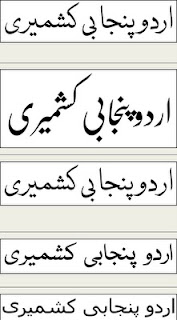
When you learn to write, it matters where you learn this skill. You may learn to write in a different script, and the characters may look different from what is considered to be the standard. The examples to the right show fonts that are usable for the Urdu language. Some reflect how Urdu is written manually. for instance in the Nastaleeq style.

Of the examples to the right, the one at the bottom comes with some versions of Microsoft Windows, the others are developed with Urdu in mind by the Center for Research in Urdu Language Processing. As Urdu uses its own set of characters of the Arabic script, it is no wonder that Urdu has its own keyboard mapping as well. This is available from the same organisation..

Urdu is a good example that when you support languages, you cannot take too much for granted. It also indicates that as we develop software intended to support languages we will need people knowledgeable about their language. People who are willing to test the software we develop for all languages.

These same people may help us provide, amend and verify the information that exists in standards like the CLDR for their language. We need to build teams of people willing to support their language. This will not only help us get the best out of MediaWiki, it can have a much bigger impact when we do this well.
Thanks,
     GerardM

Sunday, August 14, 2011

Dear #Wikimedia chapters; a request for funding

#ttfautohint is a tool that helps people who design fonts. It removes a part of the design process that is a mystery to many font designers, it is boring and it is one part of what makes designing fonts expensive. This software provides functionality to Windows, Apple and Linux. It works well for the Latin script and it will provide prototype support for Arabic, Chinese, Japanese and Korean. It will provide hooks to other font design tools.

When you look at the Arabic example, you will notice that the characters do go from top right to bottom left. This is how I am told Arabic looks like when a "proper" font is used.


Santhosh is enthusiastic about ttfautohint; he pointed it out to me. When you watch the video, you will learn that a sum of $ 30K is needed to improve the system. They are looking for the full funding by October first.

This is the kind of investment that will lift the look and feel of all of the Internet. It is open source. It plays nice with the development of the MediaWiki WebFonts extension. It is something that any chapter flush with cash can support. When a chapter like the English chapter has given their excess cash to the WMF, it is likely that they may consider such a request from the English chapter positively.
Thanks,
       GerardM

Monday, July 25, 2011

Why make new #fonts

I subscribed to the blog of UnderstandingFonts. An organisation that is in the type design training business. One of the questions they obviously ask is "Why make new fonts ?". Obvious because when there is no reason for more fonts, there is no reason for their business.

The arguments they provide are good. They are applicable to Wikimedia projects as well. It does make sense for Wikisource or Wikibooks projects featuring historic content to have a font that reflects the historic character.

The problem with fonts is that they are often incomplete. Typically a subset of the characters of a script are selected. When a font is freely licensed, it is possible to add to the existing work and add those characters that make a font usable for another language.

This is of particular relevance for the fonts that will be used as web fonts by the Wikimedia Foundation. At that, it would be good to have a tool that checks for what languages a particular font is usable.
Thanks,
       GerardM