Showing posts with label Israel. Show all posts

Tuesday, January 03, 2017

#Wikidata - Biblical truths and Wikidata practice

When you deal with historical figures, what is known for them is often because of material of a historic nature that is left to us. There is a wealth of material in the bible. It tells us about kings and kingdoms and finding references outside of books like the bible helps us get a more historic picture.

The names of kings from other historic countries are often spelled in many ways and it takes a lot of hard work to research such issues. I do no research; I reflect what I find in Wikipedia in Wikidata. At that I am restricted to what is possible in Wikidata.

At this time I am working on kings of the kingdom of Israel; this is a breakaway country that split off and the country that remained with the ruling dynasty; the descendants of David and Solomon were called the kingdom of Judah. The Wikidata practice is: we can not use names that change over time. We have only one prevailing label. This makes David and Solomon kings of Judah.  The counter argument is that biblical categorisation has it that there were multiple kingdoms. The problem is that when Rehoboam lost part of his kingdom, he was not made a king anew. He just lost part of his country and consequently it is the same country.

Both Wikipedia and Wikidata practice have room for improvement. It would be nice when we could have a label and associate it with dates. We cannot. What we can do is not have a king of Israel as a citizen of the modern Israel but as a citizen of the kingdom of Israel. In Wikidata it is easy to remedy because no modern Israelite died before 1948 and we can query for it.

The problem is that Biblical truth means Biblical expectations and Wikidata is not able to provide it. The question is how to resolve it for the time being.
Thanks,
      GerardM

Sunday, January 01, 2017

#Wikidata - Kings of #Israel and kings of that time.

When you ask: what kings lived around the year 0 east of Bethlehem, it seems obvious that Wikidata can only provide monarchs who lived around that time. Another perhaps better approach is to seek monarchs that were actually ruling at that time. This because it is better known when these people held office than when they were born.

Historically, the Jews did have their own kings; Saul, David, Solomon are the best known. There was no continuous lineage until king Herod. There were separate kings for Israel and Judah and from 140 BCE–37 BCE the Hasmonean dynasty ruled.

It is really interesting to know what rulers lived when and where and who were their contemporaries. But for it to make sense you want a display similar to the one I reported on before. It also means that some falsifications to what I perceive as the truth are removed. These kings of Judah are known as kings of Israel. They were not. Only by separating them out do you get a perspective that is historically correct. The problem is that you may get into a fight with religious people. They care for a name; was David for instance king of Judah or king of Israel.. (The Israelite revolted)..
Thanks,
     GerardM

Tuesday, October 13, 2015

#Histography - History explored with #Wikipedia


If you have not seen Histography yet, go and see it first. It is really great fun. Chances are that you do not get back to this blogpost :). Histography is a wonderful user interface created as a final project in Bezalel Academy of Arts and Design.

There are several things that peek my interest; it says: "The site draws historical events from Wikipedia and self-updates daily with new recorded events." They may have written their own software, they may have used Wikidata for it. Suppose that the software is freely licensed and suppose that it uses Wikidata.

Straight away it becomes a potential user interface for all kinds  of tasks. It may use labels from other languages making it multi lingual. It may show the items where there is no such label in a different colour inviting you to add labels, It may even invite you to write a Wikipedia article in that language.

Histography is a wonderful approach. The beauty is not only in what it does, it is also in what it can do.
Thanks,
      GerardM

Sunday, November 06, 2011

Old #Hebrew shown as it should

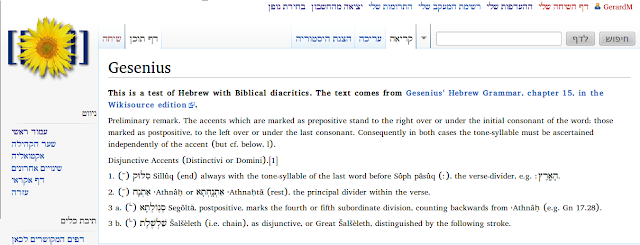
When #Wikisource is to host old sources, it helps when the resulting digital text looks old. Particularly when the way a language is written changed over time, using a different font helps.

In Hebrew, signs may be added to a text that indicate how a text is to be chanted. Such signs are not well supported in most operating systems. Amir has added a default font created by the Culmus Project for texts in old Hebrew (language code hbo).

Testing the waters in this way, a next addition for old Hebrew may be a font that will do justice to manuscripts like the Dead Sea scrolls. It means that our digital text will resemble closely what the manuscript looks like. Having all the characters show properly and in the old style will add respect to the original text.

Once a transcribed text shows visibly the same, it will give added validity to the use of our digital text for comparative research. A project transcribing the Dead Sea scrolls is the kind of project that will make Wikisource shine.
Thanks,
      GerardM

Thursday, September 29, 2011

Happy Rosh Hashanah and happy Dussehra

Today at dusk it will be Rosh Hashanah (ראש השנה). Amir my colleague is looking for pomegranates, something traditional to eat at this time.

Alolita my colleague told me that the Dussehra (ಮೈಸೂರು ದಸರ) ten day festivities also started today.

As this is the day when the Localisation team is together for the first time, I am happy and I wish you all a joyous day wherever you are, whatever you do.
Thanks,
      GerardM


Saturday, August 13, 2011

#Wikimania recordings find their way on #Youtube


Reasons to be cheerful; Wikimania recordings are finding their way on to the Internet. This time I can be happy that I spend so much time networking and not going to all the presentations. I will still be able to see them, to comment and ask questions.
Thanks,
       GerardM

Addendum: His slides can be found here.

Monday, August 08, 2011

#Wikimania was great, WikiIndia is in November


Wikimania was great. It was awesome, great organisation, great ambiance, great people to meet. It has come and gone and now I am really looking forward to the presentations I have missed. All in all I was impressed; a big thank you to all the people whose hard work made it the success it was.

In November there will be another important Wiki conference. Wiki Conference India will be three days packed with all things relevant to India, the Indic language Wikipedias and how to raise awareness for our projects in India.

This conference will not be a mini Wikimania in India, it will be much more centred to the languages and countries of what used to be the British Raj. One reason is that countries like Bangladesh, Nepal and Myanmar very much face the same issues. It is hoped that this conference will help them as much as any of the Wikimedians in India proper.


At this time there a "request for papers" has gone out. It means that we like to hear from people who want to present at the Wiki Conference India. :)  Talks about how to improve facts about India on the English Wikipedia will certainly be considered. :)
Thanks,
        GerardM

Sunday, August 07, 2011

Introduction to hacking #MediaWiki

One of the innovations at #Wikimania was a session during the hackathon where MediaWiki was explained to programmers new to the code. The origin of this session was because people with no experience asked if they were welcome.

As we like to welcome everybody, it was felt a good idea to reach out to these people and spend some time explaining the magic behind our software.

As MediaWiki is getting older, it also becomes increasingly difficult to understand. Yes there is documentation and, yes a lot of effort goes into the documentation. It is however quite different if you have to find your way on your own or if you are taken gently by the had and introduced into all the vagaries of our software.

This session was a success. In the end two thirds of the participants had actually done some work. If anything, this is the kind of session that is worth repeating.
Thanks,
      GerardM

Friday, August 05, 2011

Reasons for multiple fonts

At #Wikimania I spoke with people who conserve old texts. We spoke about the fact that the shape of characters has changed over time. This is also true for for instance Hebrew.

When a website provides webfonts, it is possible to show a text that has been transcribed in a font that uses the same shape for the characters as used in for instance a manuscript. This in turn will make the experience of reading a historic text just a little more authentic.

The drawback of old text with differently shaped characters? You can not scan them and consequently the process of optical character reading is problematic as well. This does not mean that it cannot be transcribed, it is just more work.
Thanks,
      GerardM

Tuesday, August 02, 2011

#Wikimania 2011 has its own first day cover


It is quite an honour the Israeli post office has given Wikimania 2011. We have our own first day day cover. In a circle there are all the Wikimedia projects with the Wikimedia logo in the middle. What I really like is that the stamp has the WMF logo as well. Really nice.

The one thing I do not have an answer for is, what license is this image. 
Thanks,
       GerardM

Sunday, July 31, 2011

SPQRobin does #Haifa

Tomorrow I am travelling with Robin to #Wikimania. We are looking forward to meet our Wiki friends irl. We will have fun meeting new and old friends and we may see the sights of another beautiful city.
Thanks,
      GerardM

- Who is SPQRobin in real life

I am Robin Pepermans and I live in Flanders, the northern part of Belgium. I just finished my secondary education, having studied Latin and modern languages. My next studies will likely be Public Administration and/or Translation Studies in Ghent. I started editing the Dutch Wikipedia in 2006 under my username SPQRobin. At that time I was very interested in Roman history and the Roman Empire. Even though my interests quickly shifted, I remained known under this nickname since then.

- You are involved in multiple projects, what are they and what role do you play

As I become more active in the wiki world, I discovered Meta, Commons, and also the Incubator. It was a relatively new project, where new language editions of existing Wikimedia projects are developed and maintained until they are active enough to have their own sub-domain. Incubator was however not maintained well, so I improved it and helped the users there. A few more people joined me, and there is now a little group who maintains the Incubator. Not only was Incubator itself not maintained, the process to start a new wiki was often slow and people kept asking when their wiki would be created (sometimes with no response). To improve communication, I became a member of the language committee in 2009. This committee is in charge of deciding which Incubator wikis are ready for creation. Incubator, being a special wiki like Commons, required some software features that are not easily available in MediaWiki. Therefore I applied for commit access so I could create a MediaWiki extension that provides these features. It took quite some time for this extension to be enabled, maybe because Incubator is a lesser-known project and not a high priority. I am working further on this extension, for example the plan (that especially I and Milos Rancic are pushing forward) is to make subdomains of non-existing wikis (e.g. xmf.wiktionary.org and yua.wikipedia.org) redirect to the respective welcome pages or main pages at the Incubator, (xmf Wiktionary and yua Wikipedia).

- Lately you have worked on bugs that have to do with RTL languages like Hebrew and Arabic. Are these patches in production and what are these patches about

Recently I became more involved in fixing bugs and making the software better. It was clear that a lot of the interface and features had poor support for right-to-left languages, even though a lot of the RTL bugs are relatively easy to fix. You don't have to be able to read an RTL language to be able to fix them :-) I noticed that ResourceLoader included CSSJanus, which automatically flips CSS, making the software A LOT better and easier to maintain for RTL interface. Even the old bug 6100 (interface direction should follow user language and not content language) would be fixed. However, the content was flipped as well, so this was disabled. I fixed this issue, along with many others, and I generally improved the directionality support of MediaWiki. These improvements are now part of the upcoming MediaWiki 1.18, and will hopefully soon be deployed on Wikimedia wikis. You can already enjoy the improvements on e.g. translatewiki.net, which always runs the latest software. If you have any bug reports or suggestions regarding RTL interface, don't hesitate to contact me :-)


- You are going to your first Wikimania, what do you expect

I am really looking forward to my first Wikimania. I hope to see a lot of people who I know from Wikimedia in real life, and to meet other people as well. I am going to the developer days, where I will talk about my RTL work and improve it even further with other developers, especially for the issues that I am not able to fix myself :) I could also talk about the Incubator improvements that I am developing, such as the welcome pages for non-existing wikis.

Since Belgium, my country is one of the few Western countries without a chapter, I might talk with other Belgians and Dutch people about a possible Wikimedia Belgium or even a possible Wikimedia Benelux.

The sad thing is that the developer days coincide with the Global South Meeting and Chapters Meeting, which both seem to be very interesting.


New wikis in 2010
- How many more languages will we support in two years time

Currently we are growing quite slowly in my opinion. There are yearly some ten to twenty new wikis opened, most of which are in European languages. Sometimes there are promising projects organised, that want to help languages in the Global South to get their Wikipedia, but then I didn't hear of them anymore. My hope is that the chapters set up such projects. For example India, Indonesia and Australia are starting to become active in helping small languages get support and get their Wikimedia wikis. South America is less active but I hope they will join too.
 -Robin

Tuesday, May 17, 2011

#mwhack11; Sumana tests #Hebrew on her #Nokia

The test Hebrew #WebFonts on an iPad was not a success. As Sumana had a nice Nokia, we asked her to help us test its functionality. Amir was ever so happy that it works as designed.


When people have spare time on their hands, translatewiki.net will be really happy when people do some localisation on their smart phones.

When people know that their mobile phones is smart enough they can while away the time a few translations. It is quite relevant when you help out by testing your mobile against the WebFonts at translatewiki.net.

Now it is about localisation, but it will also make a difference for people who will be reading Wikipedia once it works properly in PHP.
Thanks,
      GerardM

Sunday, May 15, 2011

Amir tests #Sourashtra on the #iPad

When #MediaWiki supports #WebFonts, it is important to test it on devices. Sourashtra is supported with the Pagul font and, when we can get our hands on a fancy device any excuse is a good one. Including the testing of web fonts.


The iPad does not support Sourasthra so it is worth the effort to see if it works with WebFonts.. The happy smile on the face of Amir tells the story.

Further testing shows that not everything is great on the iPad. Amir being Amir, he tested Hebrew web fonts with vowels. This is where the iPad could do better.
Thanks,
      GerardM

Saturday, May 14, 2011

#MediaWiki has <ref>; but look at it in #Hebrew

The #mwhack11 is an important meeting to squash bugs. As the Language committee has its meeting and as there is a large group of translatewiki.net developers, there was a dedicated session on "right to left" issues.

Some five bugs were squashed. They were the known bugs, the bugs that were documented. There were bugs that had so far not been given the attention they deserve; one bug kills the wish to actually use references in a Wikipedia article.

When you do <ref> some source </ref> you will get another entry in this nice reference section at the end of the article.


You can find the complete <ref> tag in the screen shot. For your convenience, it has been highlighted in blue. From a usability point of view, it is atrocious. It is so bad that even Mr Michael Everson himself was shocked.

Now there is a bug for this issue and there is a chance that the Hebrew community will overcome their reluctance to include sources in their articles. One lesson learned is; there is a relation between localised technology and the quality of a Wikipedia.
Thanks,
        GerardM

Saturday, April 09, 2011

The reward for a job well done; more work

Amir localised the WebFonts extension. Amir is on a mission, a mission to make the version at Wikisource most popular version of the Gesenius' Hebrew Grammar. He is doing good; professors and students of Hebrew in universities around the world - Leipzig, Barcelona, Geelong, not to mention Jerusalem and Tel-Aviv - are using it, because it's cross-referenced with hyperlinks and very convenient to browse.

One problem though; they complain that they have to install fonts manually to be able to read it properly. Santhosh and his WebFonts extension sounded just like what the doctor ordered.

He got into contact with Santhosh and the result is an article with perfectly displayed Hebrew in an English text due to some template magic by Amir. The template {{lang-he|סִלּוּק‎}} does not only define where the Hebrew text starts and stops, it ensures that the web fonts find their target.


me: Can we do an "interview" so that I can write why YOU want web fonts and input methods for Hebrew ?
Amir: Of course. In fact, for Hebrew it is much more important than an input method. We'll probably do something with Narayam, too, but WebFonts are really, really important.
me: why ?
Amir: Because of the diacritics. Most common fonts in most operating systems don't display diacritics correctly. They are not needed for most day-to-day texts, but they are very important for reference books, poetry and religious books. Wikipedia is a reference book; Wikisource is a collection of published literature and the Hebrew Wikisource would like to have more poetry and it looks ugly to people who didn't install a proper font; And religious books are important not just to religious Jews, but to many, many people who study the Bible for religious and scientific reasons all around the world.
me: would you prefer WebFonts to be on by default ?
Amir: I have to try the extension first, and we'll have to discuss it in Wikisource and Wikipedia, but it's possible that we shall want it on by default.
me: Do you have an URL for freely licensed fonts ?
Both academic grammar books and
nursery rhymes need good fonts
Amir: Yes, several of them. Here's one that is very good for the Bible and for language study books.
And here's another one, with a collection of more modern fonts.
me: So you would like to have different fonts for different projects ?
Amir: These would be good for regular Wikipedia articles and modern poetry. And also children's books and textbooks. It would be useful to have two or three fonts for different styles of books.
me: Would they do a good job for religious text as well making it a matter of personal preference?
Amir: The modern fonts would be enough for religious texts, too. They wouldn't we very beautiful, but not too ugly either. It's like printing an English Bible in Arial :)
me: .. and many of the fonts people have on their system are inadequate ..
Amir: Yes, some fonts that ship with Windows 7 are technically OK, but it's not very common yet, and these fonts are not freely licensed. Windows XP is inadequate, but if you install these fonts it can be fine. The same goes for Apple systems.
me: Thanks, Amir. It will be nice to have WebFonts live at Wikimania time.

Thanks,
     GerardM

Monday, September 06, 2010

The anti #Wikimania tradition, and other respectable traditions

It has become a tradition to find fault with the next venue of Wikimania. Too far, politics, gender issues, you name it the arguments you can think off they have been used.

With the next Wikimania in Haifa, it is again after the next venue has been announced, the contracts have been signed that people find fault. There is a Facebook thingie protesting against it. I guess that the people behind it know that the normal channels have not given them their satisfaction and use Facebook to vent their frustration that they feel they cannot come.

Apart from dealing with frustration, there is not much to be achieved. There are people who are prevented from coming by their government. The only way to deal with that is by having a future Wikimania in for instance Tehran or Damascus .. I would however prefer Djakarta or Algiers as it is easier on the WMF, it being an USAmerican organisation..

People who oppose forget how a venue is selected and what Wikimania is about. The candidates select themselves, the volunteers in a country, a chapter spend an inordinate amount of time to get all the details like venue, budget etc right. Another group of volunteers assess the bids by the candidates, they organise public sessions on IRC where the bids are presented and any and all issues are discussed.

Wikimania is the yearly event where any and all issues can be presented to a worldwide audience. Many people who come are regulars, many people are new and many people are local or near local. For the organising community it is a massive shot in the arm, the benefits to the editors and readers are great.

Every Wikimania has its special things, every Wikimania has its issues. Wikimania has its traditions, one of them is its troll. We do not need Facebook or other websites for that..
Thanks,
      GerardM