Sunday, June 06, 2010

Things change even in the #localisation numbers game

You may have everything under control and then, then they change the numbers on you. It is not about fair or unfair, it is about the reality represented by the numbers. At translatewiki.net, the "most often used messages" are exactly that. They will change because the introduction of the Usability software will change the composition of the most used numbers.


At this moment there are localisations for 137 languages. There are 28 languages that have a complete localisation of the Usability software. All WMF projects will have the benefits brought to you by this important project and consequently the numbers will change.

One observation that can be made in the "Group statistics in Time" is how we slowly grow towards our goal of 170 languages who have 98% of the "most often used" messages  localised. We are happy with such growth and, we are sure that we will have to scramble to reach our predicted goal by years end.

Even though they are numbers, they represent important concepts. We believe strongly that a project in a language that does not have a proper localisation works at a disadvantage. This disadvantage is the concern of its language community.

Technical problems for a language, a script are different. They are what makes a language play at an uneven playing field. It is what prevents a language like Hindi, Malayalam reach their full potential. These are the things we cannot solve at translatewiki.net.

Thanks,
      GerardM

Ordnance Survey data for #Wikimedia Commons

On its website, the Ordnance Survey, makes mapping data available in both a vector and a raster format. The cool thing is that this data is available under a license that is compatible with what we do.

The template
Because of the license and because such maps are so useful, Multichill is working on making the raster data available on Commons. All these separate rasters are not really convenient to browse these map of Britain. Needed is a tool that helps with moving from one map to the next. Multichill is working on a template called "Map tile navigation" that is to do the trick.
Thanks,The template
     GerardM

Saturday, June 05, 2010

Statistics, their use and their limits

The book
The Dutch Centraal Plan Bureau has a well deserved reputation. When political parties write their political programs, the CPB will do the maths on them. As they are independent of much political machinations, they get it "wrong" when their numbers are not the happy numbers that make up the propaganda.

Statistics at the Wikimedia Foundation is a happy story. Erik Zachte started as a volunteer to compile numbers, this became his job and the WMF boasts well presented statistics providing not only the basic facts about its projects, the report cards provide management information that allow for informed understanding of how its projects are doing.

In addition to Erik's work there are scientists and volunteers producing even more numbers. I am particularly grateful for the numbers produced by Magnus that help us build relations with GLAMs.

After such a glowing review, it seems strange that I feel a need to discuss our statistics and their use. I was told that statistics is like a bikini, revealing but not showing everything. Often statistics and consequently their interpretations start from a certain understanding. For the WMF strategy for the next five years the numbers were presented at the chapter meeting in Berlin. When you analyse those numbers, and interpret some of the accompanying comments, the conclusions can be quite different from our current understanding.

An example; the comscore numbers for Indonesia were not available. It is however easy to argue that money invested in growing its Wikipedias are likely to produce more traffic then money invested in the Indian or English language Wikipedias.

It is said that the growth in the English Wikipedia had flatlined. From an economic perspective, it makes more sense for the Foundation to invest in the Russian, the Spanish, the Portuguese or the Indonesian Wikipedias as they are growing. There are however excellent arguments to invest in the English language Wikipedia, they are not made in way that prevents criticism.

A lot of good work has gone in the preparing of the strategy for the WMF. It is sad that it is all too easy and too obvious to find fault. An open discussion of the issues and the strategy may somewhat change future activities. The investment in getting a clue about what to do in the next five years has been worthwhile because the least it offered is a clue of where we want to go.
Thanks,
      GerardM

Thursday, June 03, 2010

Siebrand is brilliant .... eh ... #translatewiki.net is

The time of our localisers is our most valuable commodity is the often repeated mantra at translatewiki.net. Consequently our system managers, our developers do what they can to make the most of the time spend by our localisers.


When you look at the user contributions of Siebrand, you find that he does not only localise in the Dutch language, he provides competent localisations in Tagalog, Afrikaans, Russian, Serbian you name it.

Siebrand is brilliant and his trick is that many of the messages in the applications are the same. We do not waste the time of our localisers by asking them to do the same thing multiple times. We use existing localisations as much as possible.

In this way we not only enlarge our output but we also improve the consistency of the localisation of the open source applications we support. This is a good thing and everybody wins.
Thanks,
      GerardM

Wednesday, June 02, 2010

#MediaWiki - #SignWriting road map

It is a distinct honour and pleasure to have Steve Slevinski as a guest blogger. To appreciate why I consider it an honour, Valerie Sutton who read it in advance wrote: "This is an outstanding clarification and history and roadmap for SignWriting software in general."

Solving a desktop issue on the server

SignWriting is a universal script for all sign languages. SignWriting is covered by open standards. The second version of the International SignWriting Alphabet was recently completed. Called the ISWA 2010, the alphabet is ready for a 10 year freeze.

I'm currently working on the third major revision of the character
encoding model called Binary SignWriting. This revision is needed for improved searching. After this revision, the data model will be ready for a 10 year freeze as well.

The SignWriting script itself has not changed in many years. We still
write the same way with the same symbols. Fine tuning the alphabet and data model, while an inconvenience for programmers, has not effected the writers. All of our data has been and will continue to be automatically converted to the latest standards.

Now that we are approaching a stable standard, we are ready to consider a Unicode proposal. Thanks to the work of Michael Everson, 1024 code points have already been reserved for SignWriting in the Supplementary Multilingual Plane. With the third revision of Binary SignWriting, we can encode SignWriting with 1280 code points, requiring 5 rows compared to the 4 rows already set aside.

Inclusion in Unicode is very exciting, but it will take years to work
through the approval process. Ultimately, SignWriting will be solved
with the desktop. Server applications will simply store characters in
the database and use characters in the HTML pages. The desktop will receive the characters and generate the appropriate SignWriting font.

People have listed the shortcomings of the SignWriting MediaWiki Plugin. Every one of these issues do not exist for a script encoded in Unicode with a desktop font engine. Once SignWriting is encoded and a desktop font is available, the need for a SignWriting MediaWiki extension will largely go away. SignWriting will just be another script. Every feature of MediaWiki will work the same as for other scripts: page titles, interwiki linking, meaningful diffs, that are written vertically...

The future is bright, but we're not going to wait and just sit still. We
have writers to help and others to inform. The current method for
SignWriting is to store the characters in the database and send images to the desktop. We are using the server to solve a desktop problem.

The implementation of the open standards is called the SignWriting Image Server. This is a general purpose server package for creating and viewing SignWriting.

The current SignWriting MediaWiki Plugin is a simple cover to the
SignWriting Image Server. For the main body of the page, SignWriting data is replaced with equivalent images. This replacement happens at a superficial level and can break linking and some other features. Digging deeper into the parser and user interface, it is possible to solve any issue, but this requires time, effort, and expertise.

The official SignWriting Wiki will serve as an incubator to mature the plugin as we develop our tools and our writers. Next week, I will be updating the plugin to use the third revision of Binary SignWriting. Detailed instructions and video demonstrations are planned for the near future. A plugin update is planned for late 2010, early 2011.

Regards,
Stephen E Slevinski Jr.
slevin@signpuddle.net

Urinals for babies ... WTF ?

The #Tropenmuseum object of this month are wonderful contraptions used in Turkey and Iran from before the pre-pamper era to keep tender babies bottoms dry.


Dry baby bums

These three objects are urinals, they provide drainage tubes for the urine of babies. The baby is wrapped in cloths in its crib and they keep the urinal in its place in order for the urine to flow in to a pot or a flask under the crib.

The wooden urinals are not that old. They were bought at the end of the last century in Turkey by an American collector. The green glaze urinal is some 1000 years old en originates from what is now Iran. This is probably a centuries old custom.

The Tropenmuseum would like to know if these objects are still in use in Turkey, Iran or somewhere else. Do you know any other methods of keeping babies dry? The Tropenmuseum is eager to hear your reaction..

Thanks,
     GerardM

Monday, May 31, 2010

Board member candidate

There was a public call for candidates for the board of the WMF. Candidates that will be chosen by the chapters and represent them. Then the period to put in a candidacy was extended because there were only three candidates.

I have put myself forward as a candidate for a seat on the board. When people want to know what I am about, they can start by reading my blog.
  • I want investment to provide the other languages with a level playing field
  • I want better information about other cultures on the English Wikipedia
  • I want to enlarge the reach of our projects aggressively
  • I think the pendulum of private communications within the WMF should swing back in the other direction
  • I want to discuss the numbers used to base our strategy on
To make a real difference on such subjects it is good to be part of those who decide. Given the many posts on my blog, the numerous contributions on mailing lists, my involvement with the development of parts of MediaWiki, I consider to be a known quantity. This makes it easy for the chapters to understand that with me they will have a friend on the board working for their benefit.
Thanks,
      GerardM

Sunday, May 30, 2010

A shot in the arm for the Tagalog #Wikipedia

Tagalog is spoken in the Philippines, its Wikipedia is one of those projects that goes up and down in traffic like a yo-yo. The last time when it went up, there was this amazing lady translating EVERYTHING.

The Wikipe-tan is seen wearing a baro't saya and can be found on ‎AnakngAraw her user page..

She is back and, her impact is already visible at translatewiki.net. The question is how and when this will translate to the traffic numbers for the Tagalog Wikipedia. The good news is that every day LocalisationUpdate picks up what became available.


It is awesome to have people like AnakngAraw around ..
Thanks,
      GerardM

Saturday, May 29, 2010

Why #Facebook, #Plaxo, #LinkedIn ...

A Facebook friend send me an invitation for new functionality. If anything, it is the last thing I am interested in.. Maybe not, it rates with FarmVille as a time waster.

Actually Facebook itself is very much a timesink. I tried it for some time but now I wish only for some of the nice bits to improve the whole Wiki experience.

I am GerardM some 460 times in the Wikimedia projects, I am registered as GerardM in many Wikia wikis, many other wikis. I wish they all allowed for OpenID so that I could manage my password once and well. I wish for a central place where I can assemble a public profile as well as maintain my private information. Such information could consist of bits and pieces from everywhere; as it is my persona that is fractured in what Facebook, LinkedIn, Google and many others publicly state about me. They mash all this for their private use anyway, why not have me make a mash out of it?

There are also these new functionalities where it makes sense to REALLY restrict who knows or may know... where I am for instance, it is not an invite to be burgled. I do want to control access to the people I trust but I do not care what applications they use, as long as these do not leak.

This is where Facebook has a problem; it has earned its reputation that they are cavalier with other people's data. They are leeches; it is their audacity that makes them "own" the private data of their clients so that they can sell it to their customers.

I would not mind aggravating Facebook's problems by federating information and profiles and only share what needs to be shared when it needs to be shared. Consider a game like Farmville in such a network.. When it is hot, it is available.. you spend your time and money without a Facebook overhead. It is for Facebook to add value and I find it wanting.
Thanks,
     GerardM

Friday, May 28, 2010

Censoring #Wikipedia

The notion that Wikipedia is not censored is an illusion. The worst part is that it comes in different shapes, is practised by several different groups and, it is hard to observe. It may be found in how admins censure editors that write "problematic" texts. It may be that people representing one culture are refused their point of view because "everyone" knows that ... It may even be the difference in appreciating editorial control versus censorship.

Censorship is very much the kind of accusation that halts any further useful talk. The arguments for or against restrictions are often a fine line with important consequences in either direction. I was asked to write about possible censorship on the fa.wikipedia but all I can do is write that I was asked. I know all to well that the Wikimedia domain is blocked while all Wikipedias are still freely available in Iran.

The worst thing that can happen to our projects is when they are blocked. This defeats utterly what we aim to achieve; providing educational content. For me it is frustrating not to know that we have a good understanding of all the cases of censorship imposed by governments. When this is what motivates the restriction of the number of sexually specific images, I find the argument compelling.
Thanks,
      GerardM

Thursday, May 27, 2010

Incubating #ASL for a new #Wikipedia in a new script

#MediaWiki is awesome; it supports some 300 languages in the many Wikipedias and in the incubator. For several hundred languages, all sign languages, there is no Wikipedia yet. Worse, MediaWiki does not support the SignWriting script that is necessary to write these languages.

There are several technical issues that need to be solved SignWriting is written in lanes; that is, they are written top down and the characters may swerve to the right or to the left. To complicate things even more, the SignWriting script is not included in Unicode. MediaWiki relies on Unicode.

It is however REALLY important to have a Wikipedia for sign languages. SignWriting is effectively a grass roots organisations that emancipates the mother tongues of millions of people who live in every country. Being able to write your language, finding your language on the Internet is something we take for granted. For SignWriting it is a school at a time, a language at a time and get to the inflection point where writing a sign language is obvious and asking for a Wikipedia is just a matter of following the procedure.


I am really happy to blog about the first encyclopaedic article in ASL; it is about Charles-Michel de l'Épée. Épée came to believe that deaf people were capable of language and concluded that they should be able to receive the sacraments and thus avoid going to hell. In a modern variation, it is the SignWriting Foundation that concluded that deaf people can write their language and should have their Unicode so that they can write on the Internet and have their Wikipedias.
Thanks,
     GerardM


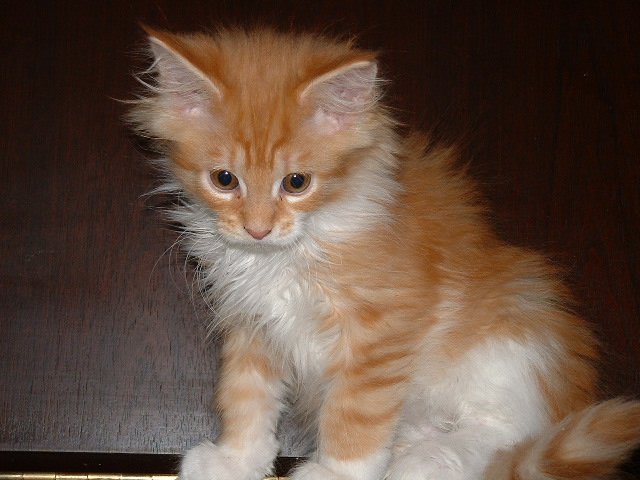
Pictures of kittens

The other day I was looking for a picture of a kitten. I was well served for my need.

The illustration is of a Maine Coon 75 day old kitten called Cookie.Kittens of the many breeds are quite distinct and, as kids all over the world present in primary school about their kitty cat, it makes sense to have the pictures of those breeds with old and young cats.
Thanks,
      GerardM

Monday, May 24, 2010

A partial #wikipedia block in #Pakistan

On Twitter I learned from Kim that Wikipedia being blocked in Pakistan. He refers to Pakistan.Wikia.com, and it refers to the BBC website. In it there is one line about Wikipedia:
Some Wikipedia pages are also now being restricted, latest reports say.

I find it quite surprising that news of blocks like this are not discussed in the many platforms for discussion. There are several aspects to it; it may be that people are not interested, it may be that people are not interested in learning about the consequences or that people are not willing to consider what it takes to get those blocks removed. Last but not least, it may be possible that it is discussed in one of the many "internal" platforms.

As there is no mention of censorship, the arguments used for it, there is no discussion about the relative merits of those blocks. In the case of China and now Pakistan some articles are blocked. It would be good when these articles are known so that we could at least better understand this whole phenomena.

A partial block is much to be preferred over a complete block because in this way the students of those countries have access to the information that is not blocked. A proper understanding of those blocks and their extend are needed to engage in a dialogue with the censors and their political masters. Some Wikipedia pages are also now being restricted, latest reports say. We have a strong argument in our neutral point of view and our educational purpose but do we really know the opposing arguments?
Thanks,
        GerardM

Saturday, May 22, 2010

#Google fonts has great potential

At Google IO an API providing web font functionality and a font directory were announced. At this time this service works on all major browsers; Adroid and iPhone are not yet supported.

It is common for Google to start new projects as beta projects. The idea of Google providing font support is something I wished for, not so much for the Latin script but very much for the other scripts.

When you consider that many people in India do not have proper fonts for their languages, it is painfully obvious that it is not about making the web beautiful but that it is about making the web usable. This is where Google can make a world of a difference; they can enable the Internet for those parts of the world where the Internet is still a novelty.
Thanks,
     GerardM

Thursday, May 20, 2010

#iPad, iDodo and #Android

First there were e-readers, they were closed but cheap and did one thing well. Then there was the iPad it did took over the attention from the e-readers and is a closed, expensive but more capable tool.

Adroid is different, its website talks about "what is new". You are expected to know that it is an operating system for ... eh ... Its logo is available under a CC-by license ...This operating system is available to any manufacturer and Android phones outsell the iPhone.

Understanding the i-thingies is easy because there is little to choose from. There is only one supplier. Choosing for Android is easy but then you still have to choose the hardware that serves your need best.

I have not really been paying attention.. is there already something sizeable running Android that competes with the iPad ?? Who is manufacturing it, who is selling it in my market ? Do I have to wait like Apple has me wait ??

Did I say that it is your choice what you do with your Android, did I say that it is open source, did I say choice.. your choice?
Thanks,
     GerardM

The upload wizard is off line at #translatewiki.net

It sounds so ominous, but in reality it is extremely friendly on the translatewiki.net community. Guillaume indicated that a lot of experimentation is going on to make the English version of the upload wizard for Commons just right.

All the iterations to get the user interface right will not be internationalised and localised. When it works well in English, the next iterations will be to get the internationalisation right as well.

We are happy for the consideration shown by the developers; it saves our community from a lot of useless work.
Thanks,
     GerardM

Wednesday, May 19, 2010

#Apple is said to be anti-American ....

In an editorial ZDNet government wants us to believe that when it comes to selling iPads, Apple is truly anti-American.


Apple treats the  US-Americans in a preferential manner and, to add insult to injury the rest of the world is not only below the salt they even subsidise the US-American market.

There is a need for a good title but this one is sooo wrong. The issue is not so much with Apple requiring a credit card, it is with the US banking industry not providing an adequate alternative.
Thanks,
     GerardM

A new #Wikipedia related logo just spotted in the wild

This logo was spotted quite prominently on the website of the Open Video Alliance where it is announced that Google has freed up a VP8 codec for HTML5: the WebM project. It is good news.. read all about it :)
Thanks,
      GerardM


The prodigal son

This painting by Rembrandt van Rijn can be found on #Commons.  The original can be found in the Hermitage.


I was looking for a picture of the "prodigal son" because my nephew returns home today from a world trip. His father and mother are happy to have him home and as he is vegetarian, I am sure a fatted calf will not be on the menu.

Anyway, the 35.95 MB file can be found on Commons, but there is no template for the Hermitage. As a consequence we can not even express how many page views the heritage preserved in the Hermitage generates. It would be good to be able to do so, it may open doors..
Thanks,
     GerardM

#translatewiki is not a WMF project ... duh

Every now and then projects like translatewiki.net find people who object to participating because "it is not a WMF project". In the case of translatewiki it should by now be obvious why they should; it provides an essential service to the development of MediaWiki.

Arguments like "but it does not have a privacy policy" or "how do we control its content" are coming from people who do not know or appreciate how translatewiki differs. Translatewiki means business and it does its thing without the many "carefully crafted" policies that confuse the heck out of almost everybody.

At translatewiki.net we internationalise and localise the software that is developed elsewhere. The software gets a quality check before the community starts localising and the localisations get a quality check before we commit it to the relevant source repository.

When our community does it work well, nothing changes except for the languages a message is available in. Translatewiki is part of the Wiki movement together with many project outside of the WMF that have their own niche and are worthwhile in their own right. Translatewiki is one, OmegaWiki, Wikia, Wikihow ..... the list goes on.
Thanks,
      GerardM