Showing posts with label Babel. Show all posts

Thursday, February 13, 2014

#Reasonator - a bit selective, not random

#Wikidata will show you the labels for the languages that you specify in the Babel information on your user page. This is really useful. Reasonator supports your Babel information by allowing you to import it into your personal settings. This will be the order for fall back languages when looking at labels.

New is that this information may influence the "Random item" functionality. The randomiser will shows all items, or only items with or items without a label in your languages.

These three options all have their own use cases.
  • When you want to learn about the content Wikidata holds, all items is best. It will make it obvious that there is much that you hardly understand. 
  • When you look for items with a label in one of the languages you know, you are provided with a great opportunity to add statements in Wikidata. Many potential statements are obvious from reading the text that shows when you hover over a Wikipedia link. 
  • When you go for the option of no labels in any of your languages, you have the opportunity to add labels when you can make out what these articles are about.

The bottom line? Add your #Babel information on your Wikidata user page, import it in Reasonator for added fun.

Monday, February 10, 2014

#Reasonator - improving your personal space

The best kept secret of #Wikidata? It must be the effect having a #Babel template has on your experience. It is how you set up the languages you want to see the labels for on a Wikidata page.

Not many people have this set up; currently there are only 1755 people have indicated they know English.

By adopting the possibility to import your Babel information from Wikidata, we hope that more people will set up their language preferences.

What we hope to achieve by keeping your language preferences in a cookie is that you will see more labels that you actually understand :)
Thanks,
     GerardM


Tuesday, October 29, 2013

Using #Babel should be obvious in #Wikidata

When you know multiple languages, you want to see the Wikidata labels used for the languages that are relevant to you.

My current list of languages is defined using the #Babel template on my user page. The syntax is:
{{#babel:nl|en-4|de-3|fr-1|ar-0|id-0|jv-0|ase-0}}
It makes a world of a difference when you are able to add useful labels in the languages you know. Added labels ensure that subjects can be found.
Thanks,
       GerardM

Monday, May 14, 2012

Benefit from the #MediaWiki Babel extension

At #translatewiki.net a Northern Sami Wikipedian asked for and was given translation rights. When a person wants to localise in a language, we ask to provide us with information about the person's proficiency in the languages he or she knows. At translatewiki.net we use the Babel extension for this.

When the Babel extension is not localised, I often ask people to localise Babel. This time the person had not provided us with the opportunity to send him an e-mail so I went to his profile on the se.wikipedia.org to ask the question.

On the profile page I found his Babel information provided by templates and as you can see to the right, many templates are missing and some like the one for Swahili and Japanese are incomplete. I copied his Babel information to my talk page. For some of the languages there is no localisation but the information is now at least readable in English.

The templates provided me with enough information to localise some of the Babel messages in Northern Sami. All that is left is for these messages to be distributed to the Wikimedia projects.
Thanks,
    GerardM

Thursday, February 02, 2012

"I do not know the language" in more languages

When you have a user of every #Wikipedia, it is fairly obvious that on most Wikipedias you do not know anything of that language. When I provided this information on the Wikipedia in Haitian, the message came out in French.

This was wrong on many levels particularly because the localisation of the Babel extension in Haitian is hardly recent. It pre-dates the current release of MediaWiki.

The good news is that this bug has been fixed. We know that it affected the Babel extension but it would not surprise us when it affects other extensions as well.

When you find all of a sudden many more localisations available for your language, you can assume that it is because bug 33768 has been fixed by Roan.
Thanks,
       GerardM

Monday, January 16, 2012

Overcoming the #Babel effect

One wonderful #Wikimedia tradition is to welcome newbies and as I am creating a lot of profiles, I am welcomed in many languages. Probably I am getting a lot of advise on what it is I am getting into, what I can do and how welcome I am to make a difference for that community.

On all my user pages I am adding Babel extension information. Not only do I indicate what languages I do speak, I also indicate that I do not speak the language that is local for that project.

Now that the Wikimedia Foundation is testing what messages send to users makes a difference, it seems obvious that a message in a language I do speak has a greater impact than a message in a language I do not know at all.

Asking for #Babel information is in a way exactly the same as asking people for their gender; it is to make sure that we address people in an appropriate way. There are plenty messages we want to share with our logged on users. Finding the best ones, translating them and using when appropriate will make me feel more appreciated, welcome and makes me more effective as well.
Thanks,
     GerardM

Thursday, January 05, 2012

Ask and it will be given

Stating that you can speak a language has long tradition in the Wikimedia projects. For more then 280 languages there is a Wikipedia and finding someone with whom you share a language is powerful. It helps building communities particularly for the languages that have a small footprint on our servers.

At translatewiki.net we are always on the lookout for people who localise for a language that does not have the Babel extension localised. We do ask people to give priority to localise Babel and typically we are happy with the results.

We asked people to localise Babel for the Kirghiz and the Kongo language recently and both have been localised.

Have you checked if the Babel information is correct for your language? Do you know a language that may not have a translation for the strings indicating your proficiency in the language? Please check it out at translatewiki.net.
Thanks,
      GerardM

Wednesday, October 26, 2011

The original script of the #Philippines was not #Latin

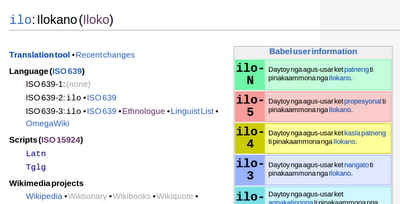
At #translatewiki.net we have portal pages for the languages our community indicates they know. For some languages all we have is Babel information, others are used to provide a starting off place for every localisation and translation we do at translatewiki.

When people are new to us, we welcome them and particularly when their language is not yet supported by the Babel extension, we ask people to localise it as a matter of urgency. At the same time attention is given to that particular portal.

The Ilokano language is one of the bigger languages on the Philippines and when you check its Wikipedia, you will find a reference to the Babayin script. This script known as Tagalog or Tglg by the ISO-15924, was used in the past not only by Ilokana but also by Tagalog. .. obviously.

The problem with this script is that it is not yet fully ratified by Unicode and consequently it is not possible to use it at all in MediaWiki. MediaWiki insists on their being a Unicode compliant font. As the technical aspects of the Unicode specification have not been ratified, creating a font is a speculative affair. Theoretically at least. Some of the gurus at Unicode can develop a font based on the existing specification and amend and append the font when need be when the script definition has some unforeseen changes.

Many of the hundreds of languages supported at translatewiki.net can do with a lot more tender loving care. When a script was used for a language, it makes sense to have the orginal transliterations in that script. This proves the authenticity of the transcription effort. A follow up transcription to the modern script makes it readable. However, transcription gets you the original orthography and that is a good thing too.
Thanks,
       GerardM

Monday, October 17, 2011

Having #Babel level 0 available is best practice

On many a #Wikipedia, people come along to do some admin work or leave a message. I have the good fortune to invite people to become part of a "language support team" for their language because the "Localisation team" I am part of do not know enough of all the languages we aim to support.


My user page looks practically the same on all the projects where I have a user for my WMF persona. The example above indicates that I do not know Catalan. The message I leave is also the same for all languages, the one I left on the Catalan Wikipedia can be found here. Obviously it is not in Catalan.

We hope to channel the communications between a language community and us through the people who can help us and who are willing to help us. It is simple, proper support for a language requires expertise and together we can provide proper support for all our languages.
Thanks,
       GerardM

Sunday, September 25, 2011

Babel #localisation is now a priority

All #Wikimedia wikis have the Babel extension enabled. Slowly but surely people are starting to use it and it does already support many many languages.

For the Lezghian language there is a Wikipedia being developed on the Incubator. As a consequence there are Wikimedians who know Lezghian and it does make sense when they can find each other.

When this extension is localised at translatewiki.net, the Lezghian portal and the Babel information on user pages will be looking great. Once the localisations are enabled for Lezghian on the WMF wikis, you can indicate your fluency for this language and other languages as well. When the localisations are a bit off, you can update them at translatewiki.net and, the next day you may be able to notice the difference.
Thanks,
     GerardM

Wednesday, June 29, 2011

In defence of social networks II

The majority of our #Wikimedia contributors contribute in more then one language and on more then one project. The approach to our projects however is isolationist. Every project is separate and there is not much that helps the cooperation between projects. There is no way that you can reliably get the attention of a wikimedian.

At this stage I have 491 users on 491 projects consequently I have to state 491 times that I am male, what my time zone is, my preferences for editing ... There are 491 user pages for me and having something sensible on them, something that is of interest is just too much effort.

Now consider that in stead of 491 user pages, there is only one user page. It has pertinent information about me that may be relevant to the communities of all the 491 projects. Something like my information on translatewiki.net. 

Now consider that an e-mail is to be send to all the localisers who localise MediaWiki from English into Dutch ... Or how about an invitation to all the people who speak Lingala to participate in an interview about their issues with editing Wikipedia.

At this time we cannot because our perspective is very much the perspective of the single project. We just found out that the majority of us is multilingual and edits in multiple languages. The social reality is that our editors can be found everywhere. We do not make it easy for them to coordinate things.

We need social network functionality because we need the social coherence that goes with a community that is all over the place.
Thanks,
       GerardM

Monday, April 12, 2010

I like the new #MediaWiki vector skin

#Commons is the first WMF project that has the vector skin as its default. As always there are people who do not like it. The best argument for it is "it is easier on my mum".

This time I will not cajole you into localising the usability software, this time I want to talk about user boxes. To indicate that you like the new vector skin, a user box has been created. It is called unnecessary but hey, if you like vector, you may want to express your appreciation.

I prefer to express my linguistic abilities in a user box and, I prefer the Babel extension for this. It is maintained at translatewiki.net and it is one of the best localised MediaWiki extensions. A little known fact is, that it allows for the inclusion for local user boxes.

The Babel extension has been requested for several Wikipedias. It has been an open request for a long time... It is not as complicated as FlaggedRevisions or LiquidThreads... What does it take for the other projects to get their wished for extensions considered / installed ??
Thanks,
     GerardM

Thursday, February 11, 2010

15 months of progress

At #translatewiki.net there is a page with MediaWiki extensions with localisations in more then 50 languages. It was not updated for some 15 months and now it shows 314 MediaWiki extensions up from 128.

The Babel extension for instance supports 186 languages and, it is an extension that several Wikipedias requested to have installed.

The Wikia extensions only recently found their way to translatewiki.net and, there are already some who have localisations in over 50 languages..

All this is possible thanks to our wonderful community, you can always check out how your language is doing; we can use help in localising, proof reading and helping us maintain and develop our project.
Thanks,
      GerardM