Wednesday, August 26, 2009

A long and great conversation on chemistry

Wikimania is special. You meet the most interesting people and have the most interesting conversations. I met Martin A. Walker who is a professor of Chemistry at the state university of New York Potsdam.. We talked about publications, about having a Wiki for all the known chemicals. the idiolect of chemist and bio-chemists, how an interface for one should use the accepted terminology for a domain.

Thalidomide has been a chemical that I learned details about and today I added to this.. Thalidomide is a racemic mixture, one is poisonous and the other benign. Nowadays it is possible to create only the benign form of the drug. There is one catch, when the stuff gets into the body, some of it will be converted in the other form making it unusable for what thalidomide became infamous for: morning sickness.
Thanks,
      GerardM

PS Martin gives a presentation about Offline releases of the English Wikipedia and Improving Wikipedia by organising and assessing articles.

Tuesday, August 25, 2009

Almere city archive's digitisation effort

Almere is the city where I live. The first house was finished in 1976 and it became a municipality in 1984. One of the first cafes opened was "the groene wig".

As the Almere city archive is digitising its archive material like this becomes available. A friend of mine send me an e-mail about this.

I am in Buenos Aires a city with a rich history and it is easy to understand how a city like Almere can and does publish the fruits of its labour. I wish the archive of the city of Buenos Aires has the resources not only to digitise its archive but to publish it as well.
Thanks,
      GerardM

Saturday, August 22, 2009

A numbers game

Many Wikipedians are not that positive about celebrating high numbers of pages.. For translatewiki.net it we think it is a bit different. More pages means more localisations and that is good. I read this on IRC..

[21:46]<Nikerabbit>we are 25k pages away from one million pages

To put that into perspective: the summer rally brought us some 35k pages, so when will we celebrate ?
Thanks,
      GerardM

The Wiki loves art /NL is being uploaded

Just one picture from one of my favourite museums out of a stream of pictures being uploaded to Commons.
Thanks,
      GerardM

Thursday, August 20, 2009

A conference call with a man in the middle

Today we had our first conference call with the Tropenmuseum and people of the Indonesian chapter. The conversation was not as easy as it should have been due to a failing microphone at the Tropenmuseum. It is not nice to be the man in the middle in a conversation where you wanted to just listen..

It was still a fruitful conversation; we learned that a large part of the collection has been selected and, the Dutch annotations for a thousand pictures will be send as a pilot to learn how much of a job it is to translate all the annotations for all the planned 100.000 pictures. They typically use the old spelling for people and places. It was indicated it would be best when the modern Bahasa Indonesia names would be used.

We learned that at this moment a group of Indonesian Museum people are being trained at the Tropenmuseum and that the expertise to deal with photographs in Indonesia is at this time largely with the Universities. The Tropenmuseum sees the Commons project as an opportunity to share this material that is part of the Indonesian cultural heritage to the Indonesian people.

A lot of information was shared but the goal of this call; building relations between the museum and the chapter would have been much better if technology had worked with us and not against us.
Thanks,
GerardM

Wednesday, August 19, 2009

WIki loves art /NL comes to an end...


All good things come to an end. For Wiki loves art /NL, the end is a new begining these pictures can now be used in Wikipedia. All the 5.413 photos are being uploaded from Flickr to Commons. A jury selected the best 10 pictures and are now approaching the photographers in order to be able to find a winner.

An extra prize is available for the best "behind the scene" picture. It is a nice picture of the garden behind museum Boijmans van Beuningen.


At this very moment Multichil is busy uploading these pictures.. A great project comes to a close, many people went to the Dutch museums, Wikimedians were welcomed in fourty six museums.. A great start to build relations with the Dutch GLAM.
Thanks,
     Gerard

Postscrip: I just learned that the majority of the pictures will be uploaded later in a few days time... some niggly bits crept up.

Ζαχαρίας Διακονικολάου blogs as my guest today :)

When I first got the mail about the translatewiki.net rally I decided to participate. I had missed the previous rally (December 2008) for only a few messages and so I wanted to contribute from the beginning in order not to miss it like before.

I started contributing from the first day of the rally and I finished the 500 new translations in the second day. I was translating in the MediaWiki extensions. Then me and Omnipaedista decided to finish the MediaWiki core which had only a few messages left untranslated and after that the Extensions used by Wikimedia. The work there was hard (big and difficult messages) but we finally achieved it.

In the whole effort I was looking in the translator score because I wanted very much to be the first one in the top of the month and the week. Also, another thing I wanted was to improve a lot the statistics of the Greek language. Besides that I also worked with the Pontic localisation in order to work on FreeCol.

By making all these many things were achieved. The Greek Wikinews completed the localisation requirement. My knowledge in Pontic was improved a lot and learned a variety of useful things in it. The Greek language had a brilliant progress in localization. But the main thing is that I became more familiar with translate wiki, I understood much better the system, and that I experienced something very useful for me.

Of course, everything we achieved during the rally should be maintained. That is why there are 3 Greek translators (me included) that will be looking on the interface to update it and translate the new messages.

In the future, the biggest goal is to complete the greek language localization. Some other goals which I would like to achieve is to get in the top 50 translators and reach the 25% of FreeCol in Pontic language. So generally I am not planning to disappear from translatewiki.

Finally, I would like to thank Gerard for the honor of being the first guest in his blog and all the translatewiki Staff that made this rally take place. I hope that there will others too in the future.

Thanks,
     ZaDiak

Rally update

The translatewiki.net localisation rally has ended. There are 36 people who can claim their part of the 1000 EURO prize we have been donated for this purpose by the Dutch chapter.


The big winners are the people who use MediaWiki; their readers and editors. Localisations have been done in Romanian, Greek, Arabic, Indonesian,  Lithuanian, Finnish, Italian, Slovenian, Simplified Chinese, Croatian, Occitan, Brazilian Portuguese, Tarandine, Catalan, Danish, Hebrew, Breton, Estonian, Macedonian, Thai, Mongolian, Afrikaans, Swedish, Polish, Nepali, Hungarian, Khmer, Cebuano, and Esperanto. All of these languages gained at least 500 or 1000 new localised messages.

A big thank you to all the participants. I hope they will appreciate the importance of their work and continue to support their language by localising MediaWiki.
Thanks,
      GerardM

Tuesday, August 18, 2009

Commons preferences when your language is Arabic


This is a screenshot that shows the user preferences in the Arabic language when you are on Commons and when the browser is Firefox on Ubuntu.
Thanks,
      GerardM

GLAM WIKI recommendations


The recommendations resulting from the "GLAM-WIKI: Finding the common ground" conference have been published. They provide an interesting and recommended read for everybody who has an interest in the relations between GLAMs or galleries, libraries, archives and museums and the Wiki world.

Most of the recommendations are brilliant they provide a solid basis for cooperation and collaboration. The emphasis on the collaboration on the metadata of material is great, this is where the benefits are obvious to me. In extension highlighting the importance of real world interaction between a GLAM and our community is dear to my heart.


The intro states that some of the recommendation are controversial. One of the recommendations indicates to me that the Creative Commons licenses are not understood because they state that a perpetual license is given to the "Licensee". We are looking for stability in the WMF projects and consequently the arbitrary removal of a license is not acceptable but there may be reasons that would be valid for us as well.

Hotlinking has similar problems; how long will our illustrations be available and, how will they be available to students and to down stream users. Most of the reasons for hotlinkinking can be mitigated by providing statistics on the use of the material, another recommendation :)

The recommendations follow the tracks of the conference; they are legal, technological, educational and business. There are separate recommendations for GLAM, Wikimedia and government. When you read them, you find that Wikimedia has its role to play. This is where our chapters may play a vital role.

These recommendations provide a start for the dialogue needed between GLAM, WMF and government. I am sure that other aspects of this puzzle will get attention in due time. As it is, I am grateful for what certainly must have been an awesome conference.
Thanks,
        GerardM

Prussian localisation

Yesterday a request was made to allow for the localisation of MediaWiki for the Prussian language. The language is being revived by entheausiasts and, they are of the opinion that a MediaWiki project in Prussian makes a difference.

Translatewiki.net has its own requirements for new languages and with an ISO-639-3 language code these requirements are met. This allows for languages like Kotava as well.

Once the LocalisationUpdate extension is available to such projects, people can maitain their localisation at translatewiki.net and all the MediaWiki installations that have enabled their language will benefit from improving localisations.
Thanks,
GerardM

Monday, August 17, 2009

How about an Old Greek Wikiquote or Wikisource

The language policy is clear; no dead languages are allowed. The only exception is for a Wikisource. For as long as the language policy exists, there was opposition because Ancient Greek is so much like Latin and, there is a thriving Wikipedia for that language.

I have been asked if I would oppose a Wikiquote in Ancient Greek. It is easy to argue that a Wikiquote and a Wikisource are both based on what is already there. One thing I do not want is for either project to have its user interface in Old Greek, The policy says that the modern version of the language is to be used for the user interface and annotations.

There are a few issues:
  • The Ancient Greek user interface makes use of Katharesouva to fill in the concepts not available
  • Ancient Greek is of interest not only to people who speak modern Greek.
The first issue is very much not for me / the language committee to decide, it is for the powers that be at translatewiki.net.

The second one is something that would work when the annotations are translated and can show up in the language of the user interface of the reader. The question then would be what the default language would be.. I could even imagine that this would be something where quotes are available in other languages as well..

All in all, at this stage it is still not clear to me how to deal with Ancient Greek. I know and respect the people who ask for it but at the same time there are technical challenges that I do not know we can meet.
Thanks,
      GerardM

FUDforum

One of our localisers at translatewiki.net asked if it would be possible to have FUDforum localised at translatewiki.net. There was an initial review some issues were indicated among them support for UTF-8 and it was even briefly considered to run translatewiki.net for FUDforum alone.

Naudefj indicated that he is willing to do most of the work and as theimmediate issues have been resolved, we now have another project that is supported at translatewiki.net.


At this moment the statistics show no activity, but a lot of localisation work has already been done as support for almost 30 languages is already available. Localisations in new languages are very much wanted.

PS The first localisations have been added while I was writing this blog entry :)
Thanks,
GerardM

Sunday, August 16, 2009

There is a lack of research on Wikipedia

For me while interesting, it is hardly new and therefore not that interesting what people like Ed H Chi write about Wikipedia. They do not write about Wikipedia, they write about the English language Wikipedia. Invariably news written about Wikipedia concentrates on just one of over 260 projects. It diminishes what Wikipedia is about and it ignores important things that are happening.

I would be interested in more study looking at the "other" wikipedias. This is where all kinds of other phenomena exist.

Yesterday Siebrand observed that there is a group of languages that have solid localisations and, the current localisation rally makes this group stand out even more.  We have the impression that this coincides with the vitality of projects; German French Dutch are top performers in localisation they have a healthy community and provide a great Wikipedia. For languages like Spanish Turkish Swedish Italian it is still possible for people to take part in the translatewiki.net localisation rally. People who participate on languages like Estonian and Khmer find that they have to concentrate on doing the most used and MediaWiki core messages first (our rationale being that our Wikipedia readers are best served in this way).

With a sample size of 260, it becomes possible to do research into the effect of localisation and the performance of a project. As the LocalisationUpdate extension is being tested for use in the WMF, timely delivery of localisations becomes a reality once it is implemented. This will give the numbers of localisation and performance a much more direct relation with each other... The question is, if someone is interested in the numbers generated by such research..

It is known for languages like Bangla that Wikipedia is the biggest resource in that language in that language, I can imagine that this is true for other languages as well. When a Wikipedia has such a status, it changes the relevance of that Wikipedia for scientists who study thea language. It is interesting to learn what the effects are on the people who use the internet in these languages. With Wikipedia being the biggest resource does this populate the Google search results and, does this make the Internet more of a worthwhile experience?

We know that things like sources, NPOV, BLP are particularly relevant on our biggest projects. On our smaller projects these things do not get the same attention. Here it is more important to have articles in the first place. The make-up of these communities is likely to be utterly different as well. Would it not be nice to understand how our projects are populated and study how it evolves over time? At what stage all kinds of policies start to kick in?

Research, the numbers they provide are important on many levels. They indicate issues, they indicate where we want to put our resources. The lack of research on the other Wikipedias make the other Wikipedias invisible, issues particular to other languages do not get attention and consequently resources needed to address issues are not available.

My argument is that there is a lack of research on Wikipedia, Wikipedia as a whole would benefit from research and indeed where the English Wikipedia's growth is slowing down, there is plenty of room for growth elsewhere of standard encyclopaedic information in the other projects. This in turn will bring up many subjects that en.wp does not cover. The existence of articles on subjects not covered in en.wp are indicative of a bias and once en.wp starts to cover these subjects it will improve its neutral point of view.. Consequently ALL our Wikipedias including en.wp will benefit from research on the "other" Wikipedias.
Thanks,
      GerardM

Friday, August 14, 2009

LocalisationUpdate update

I received this e-mail from Roan Kattouw with some great news .... He is part of the Usability Initiative team..

Just now I've enabled the LocalisationUpdate on the prototype sandbox
so we have a staging area for it. Sandbox is running r54813 (others:
please don't update the core code on sandbox for a while, kthx). You
can see that a bunch of Afrikaans localizations for the toolbar was
added in r54979 [1] but are visible on sandbox [2], even though it's
running r54813 [3]. The toolbar on Wikipedia is not translated to
Afrikaans at all right now [4].

Roan Kattouw (Catrope)

[1] http://svn.wikimedia.org/viewvc/mediawiki/trunk/extensions/UsabilityInitiative/EditToolbar/EditToolbar.i18n.php?&pathrev=54979&r1=54978&r2=54979
[2] http://prototype.wikimedia.org/sandbox/Foo?action=edit&uselang=af
[3] http://prototype.wikimedia.org/sandbox/Special:Version
[4] http://en.wikipedia.org/wiki/Foo?action=edit&uselang=af

Roan updates this environment every hour, so when Siebrand updates SVN with new localisations from translatewiki.net you will find that the environment is updated in an hour.

A big thank you to Roan, Brion and Tim who did a lot of work to make this possible this quickly.
Thanks,
GerardM

Museum looking for a camera

I was told about a small museum somewhere away from the capital of a European country. This museum is in a city with a great history and is part of a group of museums. This museum has an interesting collection of material and is willing to share this.

So they are at the stage where they might welcome a photographer to come and make pictures. As it is not a museum in my country and as I do not know what is involved, it will not be me. It may be a job that takes a week, it will not only be about making photos, it will also be about annotating the photos so that we know what the pictures are about.

The question I have at this moment is, are there people in our community who would be interested in such a thing?
Thanks,
        GerardM

Key Performance Indicators

This is my 750th blog entry. It is usual and appropriate to reflect at such a moment. My intention was to blog about the things that matter to me; this blog expresses many of the things I care about. Some of the more specialised subjects are blogged about elsewhere.

As this entry is called "key performance indicators", I will try and analyse what is important for me and where we are heading and why.

Wikipedia and language
With the recent additions, there are over 260 Wikipedias. The new ones still need to be integrated :) ... There are more languages that people want to add and there are people who do not want new language versions. The language policy is a pain; it reduced the start of new projects but the ones that start are doing relatively well.

A lot of work is done on the LocalisationUpdate, for me it is the most important new feature to MediaWiki since Single User Logon. I expect it to go life really soon.

The only reason why LocalisationUpdate makes sense is because translatewiki.net is so exceedingly successful in bringing Internationalisation and Localisation to MediaWiki. People like Siebrand, Raymond and Nikerabbit and the translatewiki community contribute the most to the success of the "other" projects. They are in my opinion the most important volunteers within all of our communities.

GLAM and Commons
I got interested in galleries, libraries, archives and museums because we need more high quality illustrations. Restoring archive material is highly effective; it removes the dirt and damage and makes it into the illustrations that we need for our articles. Histroric material trumps snapshots taken today any day.

Reasons for me approaching GLAMs like the Tropenmuseum are they are local to me and they help offset the bias in Commons with its overwhelming amount of Anglo-American material. The Tropenmuseum is Dutch and it has internationally relevant content.

Commons has another bias in that it prefers photography, digital photography.
It has some nasty consequences. Because of the opposition to a "restorationists" portal and attention to this in the same way to photographers and illustrators, there is no single place where I can point to that shows that the restoration efforts is done by a group of people.

The bias against historic material shows in the constant arguments against historic material while bugs, birds, landscapes do not get as much harasment.

Key Performance Indicators
My aim is to continue to campaign for the issues that I feel strongly about. The KPI is in getting people's attention, getting things done.

Language support for MediaWiki will improve a lot. I expect 25% more localisations over and above the autonomous growth in six months. I expect that this in turn will grow our reader and editor populations where localisation improves.

There is a need to improve our language technology. If MediaWiki is not up to it, improved language technology may come as part of the MediaWiki Wave project. Language support is quite crucial to Google. Several things are needed to tackle this:
  • priority from the WMF to ensure that our language technology is the best
  • an inventarisation of all the languages that we currently support
  • action on the language issues raised in Bugzilla
The reason why we do this should be obvious; we will be better able to bring information to all the people of this world. It is much cheaper then have everyone learn English and this is something we can achieve.

Our outreach project to GLAMs is fragmented. As we do not collaborate on an international scale, as it is considered a "chapter" thing, we are not as successful as we could be.

Personally
I was not elected as a board member, as a consequence I do not have the power to push the objectives I wish for. This does not stop me from putting them on the agenda. I was told that I am more effective as an organiser, that we can discuss new ways of doing things .. I am all for it ..

There are several other things I feel strongly about, medical information in the Wikipedias, the testing of MediaWiki environments. I hope to inform you soon about the first. I am a bit quiet about the second because of nasty legal reasons.
Thanks,
GerardM

Thursday, August 13, 2009

Translatewiki.net may partner with Commons??

Commons is the central repository of media files used by all the projects and all the languages of the Wikimedia Foundation. It currently has some 4,8 million freely usable media files.

Commons as a project is to be used in all our languages. That is a big issue and, it is an issue that is being addressed with all kinds of nifty template magic. In these templates texts are hidden and these texts are translated by Commons volunteers.

It was suggested on Commons to use the translatewiki.net functionality and community for the localisation of all these messages. As a result a great conversation started on IRC. A great conversation because it was to the point and practical.

An example message file was prepared by Siebrand, Multichil started defining messages and they are talking about the standards that are to be used. The delivery of the messages will be left to the LocalisationUpdate extension that is being worked on at the moment.

There will be around 2000 messages. It is unlikely that they will be part of the messages that will have to be localised for secondary projects... Obviously it is a good idea to localise them anyway :)
Thanks,
GerardM

The Indonesia connection

For today a skype conference call was scheduled between the Tropenmuseum and people from the Indonesian chapter. Sadly one of the key people of the Tropenmuseum could not make it so that conference call was postponed.


We had a conference call anyway, Ivan and Rani were in Indonesia with me in the Netherlands. We talked about how to prepare for a first contact, how important it is to know what a museum is, and we talked about the issues that proved to be important in my contacts..

This was a first great conversation and I hope that the many opportunities for partnership with Indonesian museums will materialise as well.
Thanks,
GerardM

Wednesday, August 12, 2009

Congratulations are due

Today I want to congratulate:
They were elected for the board of trustees of the Wikimedia Foundation !!

Today I want to congratulate the communities of the

A big thank you is due to Rob Halsell who did the creation in record time !!

A big thank you to all the people who bothered to vote !! You elected a cool group of board members.

PS Thank you to everyone who put their trust in me :)
Thanks,
GerardM

A preview of translatewiki.net

Translatewiki.net aims to make life as easy as possible for its community. It is vital that our localisers, our developers can be as effective as possible. One way to achieve that is by reducing the number of actions that are needed.

Nikerabbit in his Google Summer of Code project is working on the delivery of the message and the next.. using Ajax. I have had a preview and this is what it looks like for Maltese..


It shows the localisation in Italian because that is the fall back language for Maltese. In this incarnation, you can click in the dark area to cancel.
Thanks,
      GerardM

GLAM wiki report

Tim Starling wrote a nice report on last weeks GLAM Wiki conference. He touched briefly on two issues, the storage of GLAM material and the collation of meta data from all libraries in Australia.

The storage of GLAM material
Much of the material digitised is in the tiff format. They represent the original material best because with tiff you do not lose information due to compression. The WMF does not support tiff files in Wikipedia; at the moment it allows only for the storage of these files. There are however important reasons why we want access to tiff files; high resolution loss less files are the base material for our digital restorations.

Liam has a point when he suggests that we typically do not need the highest resolutions to illustrate our Wikipedias. But I really like the idea of Brianna where we hotlink and cache pictures from the GLAMs themselves. I can appreciate why Tim did not get into that... It is a lot of work, complicated work as well. Questions like what to do when the GLAM is off line are only part of it.

What I would suggest is that we could get the high resolution tiff on request if we aim to restore a particular image.

The annotations of GLAM material
Annotations are what makes the material we may use worthwhile. Without annotations, provenance a picture is hardly worthwhile as an illustration. The annotations in illustrations are as important as the sources for text.


In the last paragraph, there is one little gem; it says that "there is an ongoing project to collate metadata from the libraries of Australia". A similar project exists in the Netherlands for musea.

The question is very much how does the Wikimedia community fit in. To what extend does it make sense to update the data in Commons and not have this information available as part of the metadata of the GLAM. If the question of hotlinking is a hot patatoe, then this is much more complex.

Consider this scenario, the Tropenmuseum makes available 100.000 images about Indonesia. The Indonesian WMF chapter finds people willing to translate the Dutch annotations in Bahasa Indonesia and the Indonesian community starts to improve on these annotations. How will that affect the original annotations and what about the English translation that is also very much desired ??

There are no obvious answers, they will come as we work together and make our attempts to come up with workable solutions. Solutions that are bound to change and improve in time.
Thanks,
GerardM

Tropenmuseum about Wiki loves art

At the GLAM conference in Australia, a video interview with Susanne Ton of the Tropenmuseum was shown. Liam had this to say:
"The video went great at GLAM. Thank you very much for your efforts with it. We mentioned Tropenmuseums about 5 times over the course of the event. It's now definately the most 'visible' Dutch GLAM in Australia :-)"
A big thank you to Hay Kranen and Rose Klaver, they made this a really beautiful presentation. The presentation can also be seen at Commons..


Tuesday, August 11, 2009

Standards for us all

Standards are used all the time, there are so many of them and many of them are really relevant. Standards can be as "simple" as the kilo or the meter or decide on things like is that a language..

As a follow up of having been to an ISO conference in Milan, I have been invited by the NEN, the Dutch normalisation instititute, to come and brain storm about standards and how more people can be involved in the process of standardising.

I am really excited about this; for standards to work people have to know them, understand them and feel that it is in their interest to comply with them. The issues are many and accessibility to the standards and the data included in standards is a big issue. It is also very much about who benefits from standards and who pays for the development of standards.

The NEN indicated that it is very much interested in what a Wiki approach could be.. I am really looking forward to this.
Thanks,
GerardM

Monday, August 10, 2009

Updating the Serbian localisation in the Latin script

The Serbian language is written in two scripts; Cyrillic and Latin. There was a demand for the user interface in both scripts as well and a lot of work was done to do the work for both scripts.

The funny thing was that there is this script that transliterates from one into the other. Particularly the transliteration from Cyillic into Latin is easy because there are no disambiguities.

Yesterday we discussed this with one of the Serbian contributors to translatewiki.net and we decided that there was nothing to stop him from running the script for the localisations as well.

There are now 3438 localisations waiting to be committed for the MediaWiki extensions alone... It may be that this same script can be run for other languages as well...

I think our rally is a great thing.
Thanks,
GerardM

Feeling glum ...

Angelina Russo wrote why she feels glum after the GLAM-wiki conference. There are many points she raises and they deserve a response. The questions raise essential issues and this is my take on them.

Original research
When the GLAM collaborate with Wikipedia, they will not and should not take everything they have and move it over to Commons or Wikipedia. In a GLAM you may expect original research, you should expect cultural interpretation being partial, constructed, contestable when this is the very thing that the ‘new museology’ is built on.

In Wikipedia original research is not wanted and, this is understandable because Wikipedia is an encyclopaedia and GLAMs offer Wikipedia sources. When a museum expresses a particular interpretation, the result is that Wikipedia can pick this up. This is not an issue, as GLAM follows the tenets of modern museology, it will research and it does opine and it may be used as a source.

Attribution
When people write in Wikipedia, it is very clear what has been contributed. It can be found through the user contributions and it can be found as part of the history of an article. A specific version of an article can even be found through a "permalink" demonstrating what the version looked like when the editing was more or less done.

Again, writing a Wikipedia article is not scholarly research. While it is absolutely clear who contributed what and, who was how important to an article this is not science. This is writing to tell the world about a subject and explicitly writing it with a neutral point of view in mind. The question what impetus there is to contribute to Wikipedia? This is where the public is informed about your subject, writing in Wikipedia is informing the world not just a few peers.

What GLAM have to offer the Wikimedia movement
A good Wikipedia article is sprinkled with sources. Typically references are made to publications but there is an equal need to show the provenance of illustrations. As long as people are able to go to libraries and read the publications, as long as people can go to the archives and museums to see an original, Wikipedia can be trusted to inform with a neutral point of view in mind.

Why the Wikimedia movement is of interest to GLAM

Many people consider GLAM as ivory towers. This is where much historic material is stored and, where only a fraction is available to the public. Wikipedia exists in over 250 languages and they all need illustrations, they are all looking for sources in that language. The ivory towers are maintained largely by public funding and the use of the material in projects like Wikipedia gives the GLAM relevance. Relevance because their material is used, relevance because the GLAM is referred to as part of the provenance.

In conclusion:

  • GLAMs and the Wikimedia movement are natural partners
  • GLAM have their own unique role to play
    • they preserve our cultural heritage
    • they research the collections they are entrusted with
    • their social relevance needs to be appreciated in order for them to get the funding they require
    • a GLAM can gain a global audience through the Internet
  • The Wikipedia has its own role to play
    • there are over 250 Wikipedias in as many languages
    • new content is created by volunteers so coverage can be spotty
    • Wikipedia illustrations needs provenance and a reference to a GLAM is imho a minimal requirement. The complete annotation would be preferred.
As the collaborative approach with GLAM is new, time will tell what will work and how we can make things succeed. The Tropenmuseum is for me a trail blazer. They are going to upload 100.000 images about Indonesia with Dutch annotations, the Indonesian chapter has found translators who will open up this part of their cultural heritage by translating this in Bahasa Indonesia. They ask the Wikipedia community to colaborate on an exhibition that will be opened in November about the Maroon of Suriname. These are just examples of what can be done.
Thanks,
     GerardM

The rally is a hit

This is only the first day..
Thanks,
       GerardM

Sunday, August 09, 2009

What are chapters there for

Suppose you live in a wonderful country and everyone wants to live there... So over the last hundred years there has been a big influx of people. These people had children and at home they speak a different language, a more exotic language. Some of these people are second or third generation people. I could call them native and they are under the law but they still speak the language of their mother, the language where their family originated from.

Suppose this wonderful country has a thriving Wiki community so much so that it has a chapter and let us also suppose that this country has one dominant language and several languages that are quite historic but are no longer spoken in the shops, the factories, the schools.

The question is what does this mean for the chapter; when as many or more people speak an immigrant language, should they support it to the same extend as a native language ?? Should they welcome the people who speak these other languages as readily ??
Thanks,
GerardM

August 2009 translatewiki.net Translation Rally

I am happy to announce that aided by a generous donation from the "Vereniging Wikimedia Nederland" or the Dutch chapter, the August 2009 translatewiki.net Translation Rally has started.

Following the success of our first rally, we will again divide 1000 EURO among the people that contribute at least 500 new translations to the localisation of MediaWiki or its extensions before August 18 2009 at translatewiki.net.

There are some rules and they show our bias; we want to make sure that MediaWiki has the best support and therefore the most used messages need to be done first. The current status of the localisation by language can be found here.

We hope that this rally will make as much of a difference as last years rally did.
Thanks,
GerardM

Not to twitter

Twitter is not funcional at the moment. It has been facing a denial of service attack that has been ongoing for some days. I just tried to tweet and, it still does not get through.
 
On its blog, Twitter indicates that this denial of service attack is ongoing, geo-political in nature and that these types of attack will continue to be with us.
In the final analysis, it is a fundamental human right that is under attack. The freedom of expression. While it may not be directed at what I have to say, it affects me directly.
In  a way that is right; it is a universal human right and there is no excuse for this. Twitter as a company does not want to speculate who is behind this, I am not in a position to speculate but I do despise whoever is behind this and I wish that their cause falters.
Thanks,
     GerardM

GerardM's day ...

This is an unexpected surprise ...

Thanks,
       GerardM

Saturday, August 08, 2009

Translating annotations

We got some great contacts with the Indonesian community in Indonesia itself. We could not be happier; I was told that they have been looking for and found people willing to translate the annotations that are available with the images that will be made available by the Tropenmuseum.

The annotations are in Dutch, some are also in English. The translation into Indonesian that we are discussing will be really important. It will be the Indonesions for whom this part of their cultural heritage becomes accessible. It will be the Indonesians who are best positioned to assess the annotations and improve on it.

This week a conference call is planned to discuss these things.. I find it so exciting when I consider all the possibilities.
Thanks,
       GerardM

Picard is now supported in MediaWiki proper

When a request is made for a new language in translatewiki.net, it can come from many corners. As translatewiki.net is its own project, it does not follow the language policy of the Wikimedia Foundation. Consequently it can happily support languages like Kotava that do not meet the existing criteria and are now supported elsewhere.

It is also up to the developers of translatewiki.net to decide when they make the language available within the MediaWiki software itself.  As a rule this is done when at least 50% of the most used messages have been localised.

The Picard language has now been enabled in MediaWiki and, the question will be when the first messages will become available for its Incubator project. New languages are not supported in the LocalisationUpdate extension so this must be enabled in a different way. Maybe this is one of those administrative jobs that just can be requested in bugzilla..
Thanks,
      GerardM

Friday, August 07, 2009

GLAMZ and monkey business


My nephew did not celebrate his 17th birthday. Celebration is optional :) so I ended up going with him, his girlfriend and his mother to the Apenheul and had a good time.

The Apenheul is a zoo for monkeys. Its origins are in the sixties and in providing a safe haven for monkeys. There were many experiments and the most relevant one is in the succesful breeding. The black capped squirel monkey had some 30+ young and there were three young gorillas to name but two species.


I have been to the Apenheul before and the most amazing thing was the interaction between people and animals. Monkeys used to be all over you but this time, they kept their distance. They have been trained to keep their distance; the stick is a little water pistol. It is good because now I could watch a much more natural behaviour.

In a similar way as I know it of museums, you are informed about the animals, their behaviour, how they maintain a healthy breeding stock. The value of social and mature animals.

There are some people who dislike the notion of the GLAM because they argue it is about "cultural institutions" others say "cultural heritage institutions". I can sympathise with their notions however the success of the GLAM is that it is much more to the point. You do not include churches, or historical societies or even zoos in this. All of them have their value and may even be organisations we could partner with. The notion of the GLAM is sweet to me because as a group they have so many commanalities and as a group they are natural partners to the projects of the Wikimedia Foundation.

I think that the "other" cultural institutions are of most interest to us where they have things in common with galleries, libraries, archices and museums.
Thanks,
GerardM

Thursday, August 06, 2009

Apple does not like Wiktionary

Apple computer rejected an application for its telephone. The fact that they have funny notions about what its customers can buy is nothing new. What is of interest to me is that the Ninjawords dictionary is based on Wiktionary.

The argument used is that Ninjawords provides access to "other more vulgar words". When people ask me about vulgar words, I always argue that it has a clear benefit when you can learn what has been said to you. Particularly when it is also enriched with etymological information... I know that many people do not really know what they say.
Thanks,
      GerardM

Wednesday, August 05, 2009

Contact with the Indonesian chapter

We are really working hard with the Tropenmuseum. A lot of things and people are involved when you want to produce the best results when you upload a lot of data to Commons. What annotations to upload, how do you make it visually clear that the material is from the Tropenmuseum? How do you inform officially that the Tropenmuseum gives assurances about copyright and licensing? How to write a press release....

While we are preparing the upload for material about Suriname, we are doing this as the precursor to a much bigger project. Some 100.000 media files about Indonesia. Indonesia used to be a Dutch colony and as a consequence many Indonesian objects found their way into the Netherlands and became part of the Dutch cultural heritage.

While we are working on the material from Suriname, we have started with the preparation of the Indonesian material. It brings with it all kinds of other issues. The annotations of the Tropenmusuem are in Dutch, but who is going to translate that and, into what language.. both English and Bahasa Indonesia would be important for us.. While I am extatic with how this project goes, it makes sense for the people of the Indonesian chapter to get to know the Tropenmuseum and once this relation is established how do I bow out..

The Wikimedia Foundation has a need in all its projects to bring information to people. In the communities of our Wikipedias, we have people all over the world who write up about the world as they know it. What is probably the one of the more important aspects of Commons is, is that it is a repository of mediafiles that is freely licensed and is made available for the whole world to use.
Thanks,
      GerardM

Monday, August 03, 2009

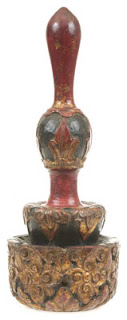
Tropenmuseum - object of the month - August 2009

This months object of the month of the Tropenmuseum originated probably in Indonesia. The question is:
  • Where does it come from
  • What is it used for
  • What is the story behind this or similar objects
Thanks,
      GerardM

Saturday, August 01, 2009

Strategy and Wikisource

In a reply on the foundation list, John Vandenberg argued for Wikisource, he asks for a bigger Wikisource community. When Wikisource is to have a bigger community, it needs to have a strategy to gain attention, it has to market itself. Wikisource has a monthly featured text. I did not know about it until I commented on "A specimen of the botany of New Holland" on my blog. In a reply John commented that I had the audacity of critiquing a featured text.

I did not even know that it was a featured text, I did not know there is a monthly schedule for featured texts and I did not know that months go by without a featured text. John commented "perhaps I should be thankful that you even know Wikisource exists, which is more than can be said for most of the other people who wish to represent the Wikimedia community".. I do not deserve such praise, it was just that this botany piece featured on the main page of the Australian chapter and I had a look.
`
We have embarked on a strategy project. Wiktionary, Wikispecies, Wikiquote are not mentioned, Wikisource is mentioned together with of all things OmegaWiki. Apparently there is no strategy being considered for these projects. Generally each community is to fight for attention and has to make its case heard. It would make sense for projects like Wikisource to make its case heard. This can start with something as simple as blogging each month about the new featured text. Wikisource could grow in relevance as a consequence of our current interest in GLAM (galleries, libraries, archives and museums).

There are things that a project can and should do autonomously and there are things where the WMF organisation can help. This is very much about strategy and as such Wikinews is much better at getting attention.

In many ways the WMF has not expressed its strategy about the other projects and as there is a clear and long list of things that need to be urgently addressed and are addressed they have an excuse. Commons for instance is effectively useless to everyone who does not speak English and there is a lot of argument about quality, the demise, the issues, the future of Wikipedia and it is understood that we talk about only one.

In a strategy brainstorm you do want all the ideas aired. In the end, there will be a selection of priorities based on what is feasible once we have ensured that our primary technology supports all our projects. This gives priority to basic language support and to the basic usability of our software. Then we have to consider enabling technology; what will help our community most in working towards what our commitment is. Then we need to support our communities and our projects to do what is best for them.

Wikisource can promote itself by blogging about their featured text. They can aim to make featured articles, featured pictures, did you knows about this text on the other projects. When they do, I am sure they will gain attention and relevance to their project. The reward should also be increased appreciation from the Wikimedia Foundation. Practical proposals for the next five years are already welcome on the strategy wiki.
Thanks,
GerardM

Friday, July 31, 2009

Supporting the Nikud characters

I use Firefox on Ubunty, the Nikud characters used in Hebrew look for me like this.
 
You see nothing. They should look like this:
It is these kind of things that need to be addressed when we support the "other" languages. It is just an example of one language that we want to support in the "Special characters" of the enhanced editing toolbar in the beta version.
Thanks,
        GerardM

Thursday, July 30, 2009

Pictures about the Maroon

The Maroon of Surniname will be the subject of an exposition in the Tropenmuseum in November. As I did not know who they are, I had a look at the articles on the subject in several Wikipedias. I found that almost all the illustrations where taken in 1955 by the father of the man who uploaded the black and white pictures to Commons.


I contacted John Hill who lives in Australia and asked if it would be possible to get new scans in the highest resolution possible. He wrote me that he will see what he can do. I talked with people from the Tropenmuseum and, they are interested to learn what kind of material we can find on the Maroon.

Do you have material about the Maroon of Suriname or the Maroon in general? Please upload it to Commons and let me know.
Thanks,
GerardM

Wednesday, July 29, 2009

The Queen of Hearts

The Wikivoices episode that is to be recorded today, will be writing an article about some famous children's rhymes. One of them is the "Queen of Hearts". The idea is that a new Wikipedia article will be created and will be brought to a level where it is a DYK.

I was asked to join and ... well not only is the text new to me but also the words are foreign to me. Words that are a bit archaic would be my excuse.. I pride myself for my English so I found my role.. I will add all the words that I do not know or that I am uncertain off to OmegaWiki.
Thanks,
      GerardM

PS the recording will start in 40 minutes...

A specimen of the botany of New Holland.

The book "A  specimen of the botany of New Holland" was the first book on the flora of Australia. The book consist of 16 colour plates  based on paintings by James Sowerbie based on sketches by John White. This book can be found on Wikisource.

My growing interest in historic material made me find my way to Wikisource and now I am intriqued to learn why the scans of those 16 colour plates have not been uploaded to Commons. After all, Commons is the repository for all the Wikimedia projects.

I am as interested in learning about other aspects of these illustrations. It says: "This is a cropped version that eliminates the indexing information" and to be honest such a crop is the last thing I would expect of a Wikisource project. It seems to me that such information is what gives this material extra relevance as a source object.

It is not clear where the original material can be found; is this book part of a private collection or of a GLAM, is it possible to redo the scans at a much higher resolution and without compression? This material is relevant and when this is the best we can have, it will suffice. It is however also an example why annotations are important because that would enable me to find out.

By pointing out these opportunities, these images may be revisited, moved to Commons and become even more relevant.
Thanks,
      GerardM

Tuesday, July 28, 2009

Rosie the Riveter

"Rosie the Riveter" is an icon representing the American women who worked in war factories during World War II. At the time, Rosie was associated with a picture by Norman Rockwell.

Accordign to a presentation by the Library of Congress, this image is no longer that well known and is largely replaced by the "We can do it" picture. What I found most interesting is that the reason given for this change is copyright.

The Norman Rockwell estate enforces its copyright and as a consequence his material is expensie. This made the original "We can do it" picture more atractive; this image is freely licensed and as it is as attractive, you will find it on posters, as an illustration even on mugs.

When copyright makes material less attractive, when as a consequence illustrations become less relevant, the way we look at history changes as well. The argument that copyright destroys the relevancy of material is a new one to me. It is however really powerfull.

Do have a look at the Library of Congress video..
Thanks,
GerardM