I read an article, I found what was written astounding and signalled that I had to read it again to really understand what is said and what it implies. The article was published in a quality newspaper; the Independent. The reply that I got was: "Indeed. And it's Fisk, so you can't just pretend it is an obscure journalist talking about something that may have happened..."
As I did not know Robert Fisk, I looked him up. I checked his Wikipedia article and found that he has indeed a reputation that is really good. He received many more rewards than was known at Wikidata so I added several and it is fun to establish the quality of its sources. For the Lannan Cultural Freedom Prize the Lannan website says it all. It is linked on the item for the award and that should suffice. For the Amnesty International UK Media Award it is not so obvious. It is conferred by te UK branch of Amnesty International and it has no dedicated page for the award. I added the award, the chapter and had a look at the pages for the award ceremony for each year. These Wikipedia articles refer to webpages that no longer exist.
For the Lannan Cultural Freedom Prize I added the other recipients because it gives some insight in the relevance of the award. I did not do this for the Martha Gellhorn prize for journalism.
The point of this all is that reputation amounts to trust about the message that is written. Read the article, it is likely that you are not familiar with the Wahhabi belief, a subset of Sunni Islam that is practiced in Saudi Arabia. The article is about 200 Sunni scholars that denounce the Wahhabi belief. Several major scholars are involved. Have a read and have a think, the article is by a major journalist published in a major news paper about something that is not without consequences.
Thanks,
GerardM
Showing posts with label Islam. Show all posts
Thursday, September 29, 2016
Wednesday, December 18, 2013
Finding #diversity in the #Ottoman Empire
In #Wikidata everybody is more than welcome to work on the subjects that they consider relevant. There is so much to do that everybody can be the king of his hill. As you gain more experience, it becomes obvious that a previous approach may not really be that good. The information about the Sultans of the Ottoman Empire could do with improvement.
Indicating that the sultan was the sultan is elementary, adding relevant qualifiers makes it informative. One other bit of information that is really important is identifying the mother of each sultan. All these women are known as the "valide sultan" and they were among the most influential people in the Ottoman empire.
Their influence was obviously theirs because in Islam going to paradise relies heavily on having parents and particularly a mother that is happy with their offspring. It follows that learning about the women in the Ottoman empire will shed light on many connections. As a sultan had several wives and concubines in his harem there was no lack of offspring. The future for most of the boys was bleak; many died at the time when one of the brothers ascended to the throne. Many of the girls were married off and strengthened the position of their husband and became really influential as mothers themselves.
These women were well educated. Their position is in a marked contrast with how some perceive Islam should treat women. It is well worth to highlight this aspect of the Ottoman treatment of women.
Thanks,
GerardM
Thursday, October 03, 2013
How to connect to #Islam
#UNESCO supports #online access to library content on the Arab, Egyptian and Islamic civilisations. As it is, it contains some 155,000 volumes. Even better, a module that will be available on the Internet is being developed for any researcher who could enrich the catalogue by data of contextualization.
When you consider the information on both Wikipedia and Wikidata about these subjects are not of the same standard, not as informative. Consider for instance the article on the Mahdian Crusade, only the Europeans are mentioned as "notable participants" while elsewhere in the article Islamic notables are mentioned by name.
Similarly subjects and people relevant to the Arabic, Egyptian and Islamic civilisations are not as well presented in external databases like VIAF. It would be cool when libraries like the IDEO library in Cairo or the library of Alexandria were connected as well. If it cannot be in VIAF, how can we enable more of the relevant literature and information they hold in Wikidata?
Thanks,
GerardM
Sunday, May 19, 2013
Sources from #Islam will benefit #Wikidata
With currently over 12,000,000 "items" registered in Wikidata, most of them registered with bots there is a monumental task waiting to be undertaken. It is adding sources to all this information stated as facts.
In Wikipedia it is policy that facts stated in an article need to be supported by sources. It is also a matter of principle that Wikipedia itself can not be considered a source itself. Stating that something is true because Wikipedia says so is good for more than a smile. Oh and, there is not one Wikipedia, there are over 280 Wikipedias; enough reasons to snicker.
One of the things people are taught in Islamic schools is that they should rely on the original sources. When something of a religious nature is stated, it should be supported by what can be read in the original sources of the Islamic faith. In Wikidata many people and subjects that have to do with Islam have found their way as a fact that is not sourced. They include genealogical information like the one shown above or similar information about Q9458.
Having sourced information is important because some information present in Wikipedia is certainly wrong. Having incorrect information in Wikidata is even worse because it may present information used in 280 Wikipedias.
Bringing together people who know the relevant sources, who are willing to learn about Wikidata and edit its information is something you can do in a workshop. Organising a Wikidata workshop together with a mosque are two novelties; as far as I am aware there have been no workshops organised around Wikidata and, organising a Wiki workshop with a mosque is something I have not heard about either.
Thanks,
GerardM
In Wikipedia it is policy that facts stated in an article need to be supported by sources. It is also a matter of principle that Wikipedia itself can not be considered a source itself. Stating that something is true because Wikipedia says so is good for more than a smile. Oh and, there is not one Wikipedia, there are over 280 Wikipedias; enough reasons to snicker.
One of the things people are taught in Islamic schools is that they should rely on the original sources. When something of a religious nature is stated, it should be supported by what can be read in the original sources of the Islamic faith. In Wikidata many people and subjects that have to do with Islam have found their way as a fact that is not sourced. They include genealogical information like the one shown above or similar information about Q9458.
Having sourced information is important because some information present in Wikipedia is certainly wrong. Having incorrect information in Wikidata is even worse because it may present information used in 280 Wikipedias.
Bringing together people who know the relevant sources, who are willing to learn about Wikidata and edit its information is something you can do in a workshop. Organising a Wikidata workshop together with a mosque are two novelties; as far as I am aware there have been no workshops organised around Wikidata and, organising a Wiki workshop with a mosque is something I have not heard about either.
Thanks,
GerardM
Sunday, November 06, 2011
Celebrating Eid al-Adha in the #Netherlands
When politics has its way, this year will be the last year when Muslims are allowed to celebrate Eid al-Adha in the traditional way. Traditionally a sheep is butchered, its meat is shared with the poor. According to a one issue political party, the "party of the animals" butchering animals in the halal way should not be allowed.
The law that effectively prevents the eating of meat by both Muslims and Jews still needs to go through the Dutch senate. My fear is that this law that may be well intentioned, will effectively have quite nasty results. At present animals are slaughtered in slaughter houses. With this law in place I am convinced that many animals will be butchered wherever because people will celebrate their festivals and they want to celebrate it in the traditional way.
Thanks,
GerardM
PS Ied mubarak
The law that effectively prevents the eating of meat by both Muslims and Jews still needs to go through the Dutch senate. My fear is that this law that may be well intentioned, will effectively have quite nasty results. At present animals are slaughtered in slaughter houses. With this law in place I am convinced that many animals will be butchered wherever because people will celebrate their festivals and they want to celebrate it in the traditional way.
Thanks,
GerardM
PS Ied mubarak
Sunday, September 11, 2011
nine-eleven revisited
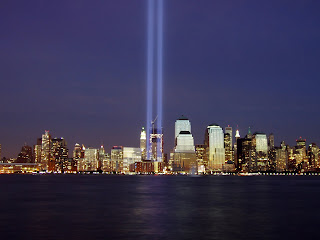
This day ten years ago, I was in a shop that had a TV turned on. I saw a plane crash into a skyscraper. The consequences have been horrible. Nearly 3000 people died in this abomination, many many more died as a consequence of the wars that followed.
Today, ten years on, I met a local imam here in Almere. The date of the appointment was quite accidental but we did talk briefly about the September 11th attacks. It is horrible when you consider how a small group of fanatics were allowed to bring so much misery on all Muslims.
Wikipedia was another subject; the need for free and neutral information was considered very important. I may even quote my imam as he said: "the biggest challenge of mankind is ignorance and then illiteracy". We had a look at Wikipedia, both the Arabic and the Dutch Wikipedia, and found that articles that explain Morocco and Islam can do with a lot more tender loving care.
Bringing Muslims to Wikipedia does not need to be more then just reaching out. I indicated that I am happy to give some instructions in Almere. I truly do not care in what language they write, where they come from, their culture. What I care about is that we will grow the sum of available knowledge and share it widely.
Thanks,
GerardM
Today, ten years on, I met a local imam here in Almere. The date of the appointment was quite accidental but we did talk briefly about the September 11th attacks. It is horrible when you consider how a small group of fanatics were allowed to bring so much misery on all Muslims.
Wikipedia was another subject; the need for free and neutral information was considered very important. I may even quote my imam as he said: "the biggest challenge of mankind is ignorance and then illiteracy". We had a look at Wikipedia, both the Arabic and the Dutch Wikipedia, and found that articles that explain Morocco and Islam can do with a lot more tender loving care.
Bringing Muslims to Wikipedia does not need to be more then just reaching out. I indicated that I am happy to give some instructions in Almere. I truly do not care in what language they write, where they come from, their culture. What I care about is that we will grow the sum of available knowledge and share it widely.
Thanks,
GerardM
Wednesday, August 31, 2011
Eid Mubarak
It
would be good when our Wikimedia communities can be happy and cheerful.
The amount of e-mails we get nowadays seems to me much less then it
used to be in the past.
A happy tone allows us to wish each other well and give the best wishes whenever it is opportune. It helps us feel good and really, truly and honestly it makes me happy whenever people wish me/us well.
Thanks,
GerardM
A happy tone allows us to wish each other well and give the best wishes whenever it is opportune. It helps us feel good and really, truly and honestly it makes me happy whenever people wish me/us well.
Thanks,
GerardM
Sunday, August 28, 2011
#Arabic characters to display the #Qur'an
Readers of #Wikipedia are still expected to have all the fonts on their system necessary to display the texts they are about to read. The Arabic fonts on Ubuntu for instance are not enough to show all the characters used in printing the Qu'ran.
The technology used in printing is not necessarily the same as the technology used in displaying on a computer screen. The result is that several characters used when printing the Qu'ran are missing in Unicode. The King Fahd Glorious Quran Printing Complex has as one of its ambitions to bring the Qu'ran to the Internet and consequently brought several proposals to the Unicode standard and the ISO/IEC10646.
As you can see, quite a number of characters are missing for me. As reading the Qu'ran, requires a high quality font, it would be a gift to the world when the font as used and developed for displaying the Qu'ran becomes available under a Free license. This will ensure that everyone can see and read the Qu'ran as it has been handed down.
Thanks,
GerardM
The technology used in printing is not necessarily the same as the technology used in displaying on a computer screen. The result is that several characters used when printing the Qu'ran are missing in Unicode. The King Fahd Glorious Quran Printing Complex has as one of its ambitions to bring the Qu'ran to the Internet and consequently brought several proposals to the Unicode standard and the ISO/IEC10646.
As you can see, quite a number of characters are missing for me. As reading the Qu'ran, requires a high quality font, it would be a gift to the world when the font as used and developed for displaying the Qu'ran becomes available under a Free license. This will ensure that everyone can see and read the Qu'ran as it has been handed down.
Thanks,
GerardM
Subscribe to:
Posts (Atom)

.jpg)