Showing posts with label celebration. Show all posts

Tuesday, October 29, 2024

the virality of co-authors in urology

Happy birthday Wikidata and, many happy returns.

When you start enriching the data for a Dutch urologist, an academic who published quite a number of scientific papers, obviously there must be many co-authors. Many of them are yet to be identified, at this moment for Jakko A. Nieuwenhuijzen there are some 339 still to be added.

The main consideration is what has the biggest impact. As a colleague of Mr Nieuwenhuijzen is known at Google scholar, adding papers for him brought new publications to Mr Nieuwenhuijzen and many of his co-authors. Enriching data for these co-authors makes the graph more complex.

At some point more precision in the data for a single author is no longer worth the effort. When you then find an other urologist with many papers not yet attributed and many co-authors where Wikidata does not know the gender yet, focus shifts and many more edits make their way into Wikidata.

Many of these co-authors are of the same institute but people from elsewhere find their place in these graphs as well. Many are Dutch but as urology knows many international collaborations this is reflected in the expanding number of co-authors. 

As a topic is developed in this way, it easily results in thousands of edits. As many subject are  researched in this way, the enriched data is there for the world to use. This data is only of value when there is a public. Sharing in the sum of all knowledge has always been what we stand for. Sharing freely and widely generates us a a both public and a future.

Thanks,

      GerardM

Sunday, January 17, 2016

#Wikipedia - 15 years

A long time ago in a country far away, they experimented with the creation of new content for an encyclopaedia because their current model proved broken. They allowed people just to write and the idea was that when it was 'good enough', it would be used in the encyclopaedia.

The new mouse trap, using a 'wiki' approach, proved effective, so much so that it easily outpaced the old encyclopaedia and replaced it. The new model became Wikipedia and people were amazed. It should not work but it did. It embodied values that were very much outside the established models of science and publishing. It broke those models and ever since, science and publishing are trying to catch up.

As it did not fit in the existing paradigms, ever since people have been eager to insist on implementing their old hat thinking because .. whatever. Wikipedia grew. People added content and some of it 'did not fit'. It is why new projects like Wiktionary, Wikinews and Wikisource started. They have their own history and community. After their effort was sidelined, effectively their community and projects were as well. They had to use the same software and attention to their needs has been inadequate.

Versions in other languages were started and each of them has its own history and community. All of them used images and all too often the same picture was uploaded. The cost involved was such that a new project started. Commons saved us a lot of money. Money that was initially provided by the founder of Wikipedia, Jimmy Wales.

Wikipedia grew spectacularly so much so that Jimmy could no longer afford it to foot the bill. The general public has been the main sponsor of Wikipedia ever since.

One of the best thing of Wikipedia are its links between articles and the links between articles in different languages. The links between the different languages were a mess and a new project, Wikidata, was envisioned to 'fix' this. Wikidata did so in a spectacular way; interwiki links are now manageable and this project is going its own sweet way.

All of those projects are works in progress. At 15 Wikipedia is very much an adolescent. A legion of loosely related projects and communities do their best to make it work. If there is one wish, it is that it will not be shackled by well meaning terrorists of reason. It was not 'reasonable' for Wikipedia to succeed and it is not reasonable that it has to fit in arbitrary molds.
Thanks,
       GerardM

Monday, August 03, 2015

#Wikidata - #featured item; László Krasznahorkai

Mr Krasznahorkai will be this weeks Wikidata "featured item". It shows off how much information may be available for the subject at hand. Indeed, a lot of great work went into including and linking all the work Mr Krasznahorkai produced over the years. Adding information like that is a labour of love.

Mr Krasznahorkai is a celebrated writer. It shows in the many awards that were bestowed on him. All in all there are 21 listed among them the Man Booker International Prize.

For many of the awards like the Vilenica Prize, it is just a matter of harvesting the data and add it to the right items; easy enough. For others like the "Hungarian Heritage-Award", it is a bit more involved because it does not exist as a Wikipedia article in English. The article on Mr Krasznahorkai in Hungarian however looks promising. Many more awards are available there.

By harvesting awards for Mr Krasznahorkai, the information on the featured item becomes even better. The best thing is that in the process all the other items for people who are known to be awarded will have better information as well. Obviously, data from English Wikipedia is overexposed as more people do know that language and it is rather rich.
Thanks,
     GerardM

Sunday, August 02, 2015

#Wikipedia - Maintaining the #Akademy award


Lydia challenged Wikipedians to update the information about Akademy. The conference in 2014 and 2015 have come and gone by now. The most interesting part of the English article is the information about the awards. There are three of them; one for best application, one for best non application and a jury's award.

Awards are important and Lydia has two main points:
  • the most important one is collective celebrating successes in a community
  • the other one is being able to communicate to the outside about the achievements
At Wikidata there is enough to celebrate. I would welcome a Wikidata award for 2015 for the reasons stated above. Sjoerd and Amir would be on my short list. <grin> If nobody reacts in time, I may even announce the award </grin>. Then again, why not steal a page out of the KDE book and have multiple awards?
Thanks,
       GerardM

Monday, December 29, 2014

#Wikidata - 2000 #categories with a #list

When people die and it becomes known in Wikipedia, often more can be said about that person than just his date of death. They may have studied, held an office, been a member of a sports team or a political party. Much of this information is registered in categories.

Thanks to Autolist2 it is easy to add all that information to Wikidata. The best bit is that we can indicate what conditions the articles in the category have to fulfill in Wikidata itself. It is picked up by the Reasonator and this shows in these 2000 categories that have had the treatment so far.

So check out these categories, click on the Reasonator icon and be amazed about the number of items that have been enriched slowly but surely.
Thanks,
      GerardM

PS You can do this as well :)

Monday, October 27, 2014

#Wikidata - #dead in #2014

A milestone is often a reason for celebration. Wikidata now knows about more than 10.000 people who died in 2014. This is more than is known for all of 2013 in Wikidata but we "know" about 4292 more people who died in 2013. For 2014 the death of some 329 humans is waiting to be registered and obviously there are two more months to go.

People wonder what the attraction is, killing people of. Registering a death is not nice; it is only worthwhile because of the potential it has:
  • Reasonator displays the latest information
  • Wikipedias can compare what it knows and what Wikidata knows
  • External sources can compare what they know and what we know
  • It can trigger attention for the people who died
It takes time for such effects to be realised..
Thanks,
     GerardM

Wednesday, September 10, 2014

#Wikidata - great progress on the number of statements

It is obvious; with 15,703,625 items, it takes a lot of effort to improve the quality of Wikidata. Statements are added all the time to specific items and that reflects well on the quality of those items but the underlying health of Wikidata is probably best expressed in its statistics.

The latest statistics show that we can finally say that "50% of our items have none, one or only two statements". Arguably not much can be said about these items and consequently these items are not informative. The trend however is wonderful; it shows in the graph; slowly but surely Wikidata is gaining data and by inference becomes more informative and useful.

The next challenge for us will be to be able to say "50% of our items have none, one, two or only three statements".. That will be a happy day.
Thanks,
       GerardM

Friday, January 13, 2012

2000

April 9, 2005 knew the first blog post and today I celebrate blog post no 2000. At the time I announced that I would promote the good cause of the "ultimate wiktionary" now OmegaWiki and at this time it has broadened to the support of Wikis, languages and things I find relevant.

Blog post no 1000 was only two years ago and number 1500 was in Februari last year. According to Blogger there have been 211143 page views and given that my blog is also aggregated the true number of page views must be larger. What matters to me is that the message of languages and language support is getting its public.

Seven years ago, supporting other languages was not considered much of a priority; support was very much focussed on Wikipedia and European languages at that. Nowadays, language support is provided in MediaWiki itself by a development team and the support includes localisation, support for gender, plural and grammar in messages, web fonts, input methods, direction.

With the increased support for languages we are getting more and more a situation where it is almost as easy to edit MediaWiki in most languages as it is in English. It is understood that we will only reach this situation when any application uses the same building blocks for language support. Once these building blocks are defined in standards, libraries and code generators can implement them making them available to any developer for any application.

There are still plenty of challenges ahead of us.
Thanks,
      GerardM


Saturday, October 29, 2011

A #Font as a luxury

#Halloween will be celebrated soon; even in my part of the world there are pumpkins, grizzly costumes and other Halloween paraphernalia to be had. 
Google celebrates the occasion with four webfonts. They are nice, fun and they demonstrate nicely how you can change the look and feel of a website by selecting another font.

Being spoiled for choice to celebrate Halloween on the Internet is good fun. I can imagine that Wikipedia main pages will join in such fun once the WebFonts extension is live on all the WMF projects.
Thanks,
      GerardM

Wednesday, August 31, 2011

Eid Mubarak

It would be good when our Wikimedia communities can be happy and cheerful. The amount of e-mails we get nowadays seems to me much less then it used to be in the past.

A happy tone allows us to wish each other well and give the best wishes whenever it is opportune. It helps us feel good and really, truly and honestly it makes me happy whenever people wish me/us well.
Thanks,
     GerardM

Saturday, April 16, 2011

#Wikimedia #Commons has its first 10 million media files

Commons, the repository of media files, is where you can find illustrations to illustrate almost anything. The media files contained at Commons are used to illustrate all the Wikipedias and all the other projects of the Wikimedia Foundation.

Before Commons, a popular illustration would be stored in all the Wikipedias that used it. This took a lot of storage and, it was really labour intensive. When Commons was created, the technology of sharing media files from a central repository was not available yet but as the benefits were so obvious, it did not take long.

Once Commons was established as a repository, a big effort got under way to move all the freely licensed images to Commons. The files were tagged with license information and they were reduced to a single copy of a picture.


As Commons became established, several projects chose to do away with the option of local storage while others kept this ability to allow for the use of "fair use" material. As the appetite of the Wikimedia projects and MediaWiki projects grew for great illustrations, Commons was discovered as a place where the cultural heritage preserved by our GLAM partners finds a worldwide audience.

Media file number 10,000,000

Having 10 million media files is a nice moment to celebrate Commons. It is a moment to congratulate all the people who uploaded their pictures. It is a moment to celebrate all the people who work so hard to make Commons what it is: a repository of freely usable media files.

The proof of the pudding is in the eating and for Commons the eating is in finding its material in the projects of students and in the illustration of wikis and websites.
Thanks,
      GerardM

Monday, March 21, 2011

Happy Nowruz


In the Netherlands it is the first day of spring. In Iran and other countries people celebrate Nowruz, the first day of the new year. As part of the celebrations seven traditional items are put on a table in a pleasing manner.
Thanks,
    GerardM

Tuesday, March 08, 2011

... may they live happily ever after ...


My neighbour is exchanging marriage vows today. I wish him and his partner all the marital bliss they can muster. My wish for them ... to live happily ever after.
Thanks,
      GerardM

Wednesday, January 26, 2011

Reportcards for each #Wikipedia language

One of the Wikipedia birthday gifts is a page with reportcards for the Indic languages. Inspired by the wonderful work by Shiju Alex, Erik Zachte prepared "at a glance" information. This is really helpful when you try to understand the vitality of particular projects.

Both for the Malayalam and the Myanmar Wikipedia there are issues with entering text properly in the Wiki. This has been largely solved locally at the Malayalam Wikipedia with an option that allows you to pick one of three choices.


Once issues with writing articles are resolved locally, it becomes clear that a similar solution is needed for Commons and wikis external to the WMF. Support for input methods has to be available together with the localisation.

At the Amsterdam hackathon, we discussed this and there is active support not only for supporting input methods in core but also for providing Indian developers with access to the MediaWiki code repository.

Providing support for input methods for the Myanmar language is critical when the Myanmar Wikipedia is to prosper and grow. When it is to be read, serving its content in both the mutually exclusive fonts from the same source would be a momentous improvement.

There is an understanding how we can move forward. The people who know how are invited to become MediaWiki hackers and they are invited to work together for an optimal result.
Thanks,
       GerardM

Monday, January 17, 2011

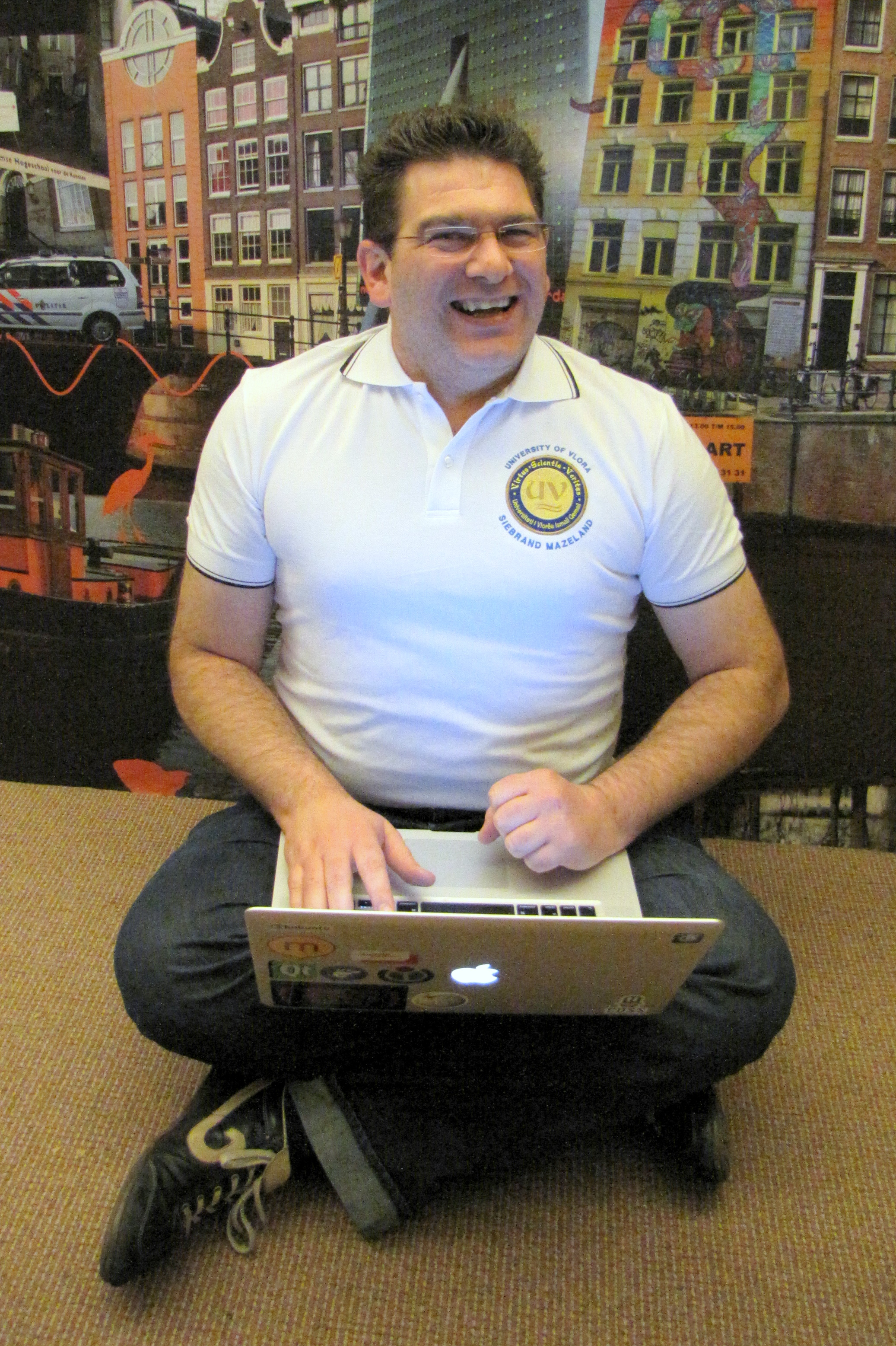
'Cause we are big and the polo shirts were too small

I blogged about the conference in Vlora #Albania. The #Wikipedia in Albanian is doing its best to grow and the conference was packed with helpful presentations. As a sign of appreciation the speakers received a beautiful polo shirt with the embroidered logo of the “Ismail Qemali” University of Vlora

Both Siebrand and myself do not even fit a size large and from an Albanian perspective we must have been larger then life.


I was quite astonished to find two polo shirts in my mail box specially made for us. They even had our names under the logo! At Wikipedia's 10th anniversary we met again and Siebrand happily posed for a picture.

So it is time for another word of thanks to Besjana. With people like her I am sure that Wikipedia will do splendidly in Albania in the coming years.
Thanks,
       GerardM

More anonymous edits at the #Wikipedia party

When you have a party and when as the tweet says "Dear vandals, all Wikipedians are drinking beer so this is your chance to have fun!" It is really nice to learn that they did not only have fun while we were drinking beer.

The anonymous editors did not only edit during the party. There were 30% more edits that day and the next day topped an already great turnout. Yes, there was more vandalism then usual, but was it also 30%  more?


It is gratifying when more people, new people find the courage to press the edit button and make a positive difference. New people will make Wikipedia their own and this will be part of the bright future Wikipedia has in front of it.
Thanks,
     GerardM

The future of #Wikipedia is young

At the decennial Wikipedia party in Amsterdam, a mother brought her two sons and a friend. They did the kids things and they were good at it. So in order to heighten their enthusiasm for the proceedings, we told them about the box with t-shirts. At that time only the small sizes were left.

As Sue has been saying, we want more women involved in Wikipedia. They may bring their kids when we party, when we get together. It makes us more whole as a community. That and is gives our community a future.


Thanks,
      GerardM

Celebrating #Wikipedia in #3D

Celebrations were held in many parts of the world. Some places had presentations, hackathons, drink, cake and it was all registered with cameras, video but ... in Amsterdam we had something special. So find that old 3D goggle and have a look at the public of the official part of the party.

Quistnix experiments with 3D photography and this IS the kind of thing that you can expect on a Wikipedia happening..

10 jaar Wikipedia - 9418 - 0450 - blik in de zaal - anaglyph

So what was out of the ordinary at your party ??
Thanks,
      GerardM

Sunday, January 16, 2011

A fabulous gift from the #AmsterdamMuseum

#Wikipedia had its party in the Amsterdam Museum. It was a full program with a #Hackaton, a chapter meeting and a party. The highlight of the party was the gift of a memory stick with a collection of 50.000 digitised images. Many of them are available in a high resolution.

In answer to my question "If you were to choose one picture out of your collection, a high resolution picture that I can propose for featured picture status what picture would it be?"

Birds eye view on Amsterdam - Cornelis Anthonisz. - 1539

This  painting of the oldest map of Amsterdam was commissioned by the city council and hung for a long time in the city hall. The north where now the Central Station is situated is at the bottom. It is clearly visible that Amsterdam was a walled city situated in an area with many waterways and at the mouth of the river Amstel. Churches, monasteries and city gates were the most remarkable buildings. The number of inhabitants in 1538 is estimated at 12,000.

As the picture that I received is less then the minimal size requirements, it is not wise to propose this picture at this time. It would have been really sweet to have proposed this on the 15th.
Thanks,
         GerardM