I was asked to blog about Mrs Foster. The argument was: "This article missed all the points why Mrs Foster is notable". One great feature of the improved article is a picture that was lovingly restored by Adam Cuerden.
Well, to be honest, I remember a presentation by Rosie Stephenson-Goodknight where she argued that the first step to get some gender balance is to write an article warts and all. It does not have to be perfect, the least it does is be there and invite scorn and improvements.
This sentiment is part of the original Wikipedia ethos; it is good to have stubs and red links. It is good to have a start to improve upon. In this sentimental spirit I improved the data on Mrs Foster on Wikidata a bit. I used Autolist to add the content of a few categories and, I added some universities she had attended.
So yes, the article has improved and it is exactly why both Wikipedia and Rosie are a success.
Thanks,
GerardM
Showing posts with label Restoration. Show all posts
Monday, July 11, 2016
Tuesday, December 30, 2014
#LOC - #Wounded Knee II
At the time I blogged about the restoration of an old photograph take after Wounded Knee. At the time there were many people actively restoring pictures as a group. This is just one of the important restaurations undertaken by Durova.
Now almost five years later, I learned that the Library of Congress included the restored picture with the original. Now that is awesome.
Thanks,
GerardM
Friday, November 01, 2013
Looking for a better version to restore and make it generally available
This is the last Ottoman sultan and his grand vizier praying before they flee their country. They take their time to pray. Love it or hate it, this is a historic picture.
When you have a high resolution version of this picture, we want it badly. Your picture will be restored as much as possible. Sadly, this picture has too low a resolution.
Thanks,
GerardM
Tuesday, July 10, 2012
#GLAM - About recognition
![]() |
Left Hand Bear, Oglala chief
|
A thread on the mailing list reminded me about all the hard work that gives images of the past a new lease of life. The image of Left Hand Bear, the Oglala chief is used a lot. As you can see below it is even used to make ties, mugs and buttons.
The image of Left Hand Bear has been lovingly restored by Adam Cuerden. The original of this image is at the Library of Congress and I owe a debt of gratitude to both Adam and the LoC.
Adam restored an image preserved at the Library of Congress. Knowing this, I am sure that this is indeed an image of Left Hand Bear. The image is obviously in the public domain and as such I am not required to acknowledge either the LoC or Adam. I may put the image on mugs, ties and buttons and sell them.
For both Commons and Wikipedia, acknowledging the LoC and Adam bring important benefits. Acknowledging the LoC provides provenance of the image, this is the equivalent of providing a source to a fact. Acknowledging Adam links the much improved image to the original. It recognises Adam for his work.
Acknowledging the LoC and Adam IS a best practice. It is a best practice promoted by organisations like Europeana. It is a best practice that is not a requirement, it is however something that we should aspire to.
Thanks,
GerardM
Monday, April 11, 2011
What is the point of publishing cultural heritage on the web II
The "Rijksdienst voor het Cultureel Erfgoed" is missing out on the benefits of crowd sourcing. When you have to pay for what is on offer, would you share the result of work done on the images made available on its website?
In a previous blog I mentioned that much of the material shown is out of copyright anyway and, claiming the availability under a restricting license is copy fraud. The illustration was a print by C. van Noordt dated 1756, and it was pointed out to that as it is a print this makes it even more audacious to claim rights.
This digital restored image of the Diever church is a wonderful example of what can be achieved in the crowd space. As an illustration it serves better then the stained original. It is also debatable if the restoration will refer to the cultureel erfgoed website. While any claim to the rights of this print is bogus, a print allows for multiple sources and sourcing it can potentially create problems.
Not sourcing it is however a bad practice.
Thanks.
GerardM
Friday, March 04, 2011
Digital restoration: making the most of what is already great
This picture of Donald Pleasence by Allan Warren shows how some tender loving care can improve a great photo into a superb photo. For me the most important part of a portrait are the eyes and their expression in a face. The picture as a whole shows a composed man, posing relaxed in front of a camera. These two crops show in high resolution a before and an after image.
A lot of work goes into a successful restoration like this.
Thanks,
GerardM
Wednesday, September 01, 2010
Support for #TIFF in #Commons
With no fanfare support for TIFF files has been enabled on Commons. This is great news as it allows us to see the many many original images as we started with them before a digital restoration. In this way the provenance of all these images is strengthened.
The above screen shot shows a tiff on commons. When you want to see a picture in all its glory, the picture is downloaded to your computer and it is presented by a program that knows how to deal with tiffs.
As you may know, the development of the software was funded by the German chapter, the software has been brought silently in production. This may be because many of the tiff pictures are not showing properly yet.
It is however great that things are coming together. I am happy with the first tiff support. Better now then waiting for perfection, this gives more people a challenge :)
Thanks,
GerardM
Monday, March 22, 2010
reminisces
When you blog as often as I do. With subjects as diverse as schizophrenic deaf people, the Tropenmuseum, translatewiki.net, statistics and what not, it is fun to look back and notice how the blog developed.Illustrations are now a must have for my blog posts. Pictures do make my postings easier to digest and, I do thank Brianna for getting that in my thick skull.
I blame my current preoccupation with numbers and statistics on Phillipe. He insists that if a point cannot be backed up with numbers there is no point. I thank Erik and Siebrand for providing me with numbers that I use to "prove" my points. PS I still think statistics show what you want them to say and, this is why many people easily ignore them
Two lovely ladies, Durova and Susanne are a joy to work with. Durova is the grand lady of quality content not only her restorations but her articles and insights are formidable. Susanne is my contact at the Tropenmuseum, from her I learned a lot about what is important to a GLAM.
As I became involved in GLAMs, I find it utterly fascinating, there are so many opportunities... There are still so many things that are only beginning... A good example is provided by the two technologies that show this magnificent story cloth in all its glory (1, 2).
Language has an enduring appeal for me. There are over 270 languages all struggling for attention, all in need of a great localisation and all relying on the support of a Raymond, a Nikerabbit, a Siebrand. Translatewiki.net morphed from a place where you could work on MediaWiki localisations to a platform where many great applications are supported.
I concentrated lately on Wikimedia mobile, the mobile phone is expected to be the device that is to become as important as an Internet device as the computer.. The number of languages with great localised support has more then tripled. Several Wikipedias now have a good looking mobile main page thanks to the pioneering efforts of the Swedes.
There are ideas of how to further improve the functionality for mobile, we want support for images from Commons.. concepts from Wiktionary..
Another lovely lady, Naoko Kamura, told me that the great new usability functionality developed by her team is scheduled to go live. Soon, really soon.
A genuine big effort is needed to get the localisations ready so that people have a chance to understand what is new and what to do.
For a blog post this is already too long... rest assured there is more to say, more people to thank and, there is room for many more blog posts.
Thanks,
GerardM
Sunday, March 07, 2010
The art of survival exhibition is until May 9
If you are able to go to the Maroon exhibition, please consider it, it is well worth it. If you are unfamiliar with marronage like I was, it is one of those uncomfortable subjects that turn out to be completely and utterly foreign. It is however utterly fascinating and the subject grows on you.
I spoke with Peter Weis about a picture and the Maroon. He found me this video.
Intro Marron exhibition from Jurgen Lisse on Vimeo.
We were talking about a digital restoration of this famous picture of John Stedman. His book about a "Five Years Expedition against the Revolted Negroes of Surinam" is a classic and was very influential in changing the British public opinion against slavery.
Preparing this blog post, I found yet another video new to me about the exhibition. It gives a nice impression of this major exhibition, an exhibition you really should see :)
Thanks,
GerardM
Friday, February 26, 2010
A much improved #Tropenmuseum picture
Raden Demang Béhé was unrecognisable in the original picture from the Tropenmuseum. The original annotation indicated the prominence of this gentleman and, with this much improved picture, we have something that is the start of an illustration.
This image is the result of work done on the material as provided by the Tropenmuseum, the improved contrast starts to bring out his face and, the pattern in his clothing starts to become apparent. A big thank you to Pete Forsyth.
I contacted the Tropenmuseum about this picture. The best quality they had was a JPG picture. This is not really usable for a restoration, so they promissed me to scan the original again. In a few days I am looking forward for a TIFF at a very high resolution.
The normal process is that we look for the feasibility for a restoration. This image will obviously need a lot of work. Often there is more low hanging fruit. This time Peter Weis has something to prove; he is talking with some German institutions and they do not see the point of digital restorations..
If you ask me, Pete has already made the point for Peter. It will only get better..
Thanks,
GerardM
Sunday, September 20, 2009
Wikivoices - Episode 48
Wikivoices episode 48 is different. Typically a Wikivoices episode is typically a topical conversion of a group of people. This time, Adam Cuerden took the initiative to explain how to edit historic sound files.He explains what to do with a great performance of Emmy Destin who recorded Rusalka of Antonin Dvorak in 1915 in Campden. Emmy Destin was a prima donna in her time and it is a great performance.
Recording of a phonograph cylinder has its hisses and ticks and Adam does a great job explaining how to use Audacity for the restoration of sound files. Audacity is a great tool for the job, there is an implementation for Windows, Macintosh and Linux and there is a localisation in many languages.
The combination of an explanation in sound and text makes for an exeptional and superb Wikivoices episode.
Thanks,
GerardM
Saturday, April 18, 2009
Provenance
When you write a Wikipedia article, you are expected to provide sources that prove the assertions made in the article. There are good reasons to do this, for articles it is not only considered "best practice" but even essential. Current practice on many Wikipedias is that articles that do not provide reliable sources may be put forward for deletion.
A picture proverbially paints a thousand words and when a thousand words in Wikipedia exists without any citations the least you can expect is a template indicating that citation is needed.
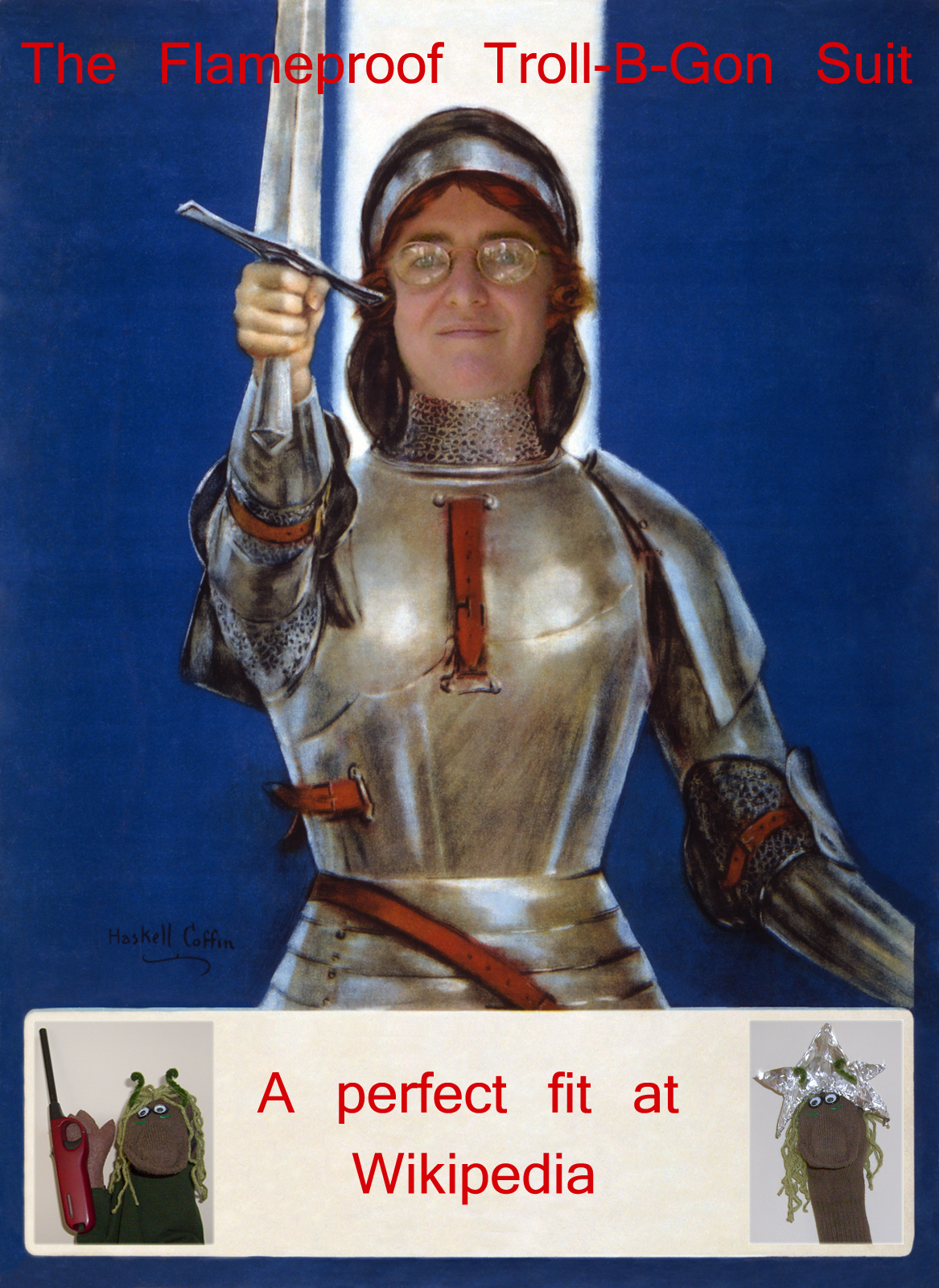
The illustration can be seen as an advertisement for what to wear to prevent troll troubles. It is however a picture that comes with excellent provenance; the original picture is referred to and urges American ladies to save their country like Joan of Arc did for France.
Both the original picture and the derivation are properly sourced and consequently you have the information you need to appreciate these pictures for what they are. This can be exceedingly important because it is the provenance that allow pictures to express their thousand words.
Falsifications are not new, and they exist for a purpose typically profit and propaganda. When you look up the word provenance, you find two aspects that are of relevance; the origin of something and the history of the ownership of something. Both are relevant to the illustrations that we use. Practically it would be wonderful when we always refer to where the original material can be found. It is then for the museums, archives and libraries to provide the complete provenance of the material we use as illustrations.
In my opinion, we should always indicate where the originals of our illustrations can be found. This has nothing to do with copyright or licensing and everything to do with us providing information that can be trusted.
Thanks,
GerardM
PS we take orders for troll apparel..
Wednesday, April 15, 2009
An exploratory meeting at the Zuiderzee museum
Yesterday I went to the Zuiderzee museum, it has a rich collection about the area where my family comes from. It shows how people lived and worked in days gone by. The museum is named after the Zuiderzee, a body of water that became fresh water after the building of the afsluitdijk in 1932 and it has a collection that is particularly focused on the people who lived near it.
The Zuiderzee museum is in the process of digitising its collection and quite a bit can be already found on the Internet on the "geheugen van Nederland" which is called in translation, the memory of the Netherlands. Many Dutch archives and museums collaborate in this initiative that aims to digitise much of the Dutch cultural heritage.
After a number of telephone calls, we had a first meeting in Enkhuizen; it was very much a "getting to know you". We talked about what is important, licenses, meta data and how to make the heritage that has both our interest interesting to our public. Having communicated a lot lately with people like Mathias Schindler, Witty lama and Durova helped prepare me for this meeting.
Given that the Zuiderzee museum is in the process of digitising its collection and is already looking at how collaboration can further its objectives, a possible relation will be much more collaborative. We did talk about our digital restoration efforts, the importance of having information with historic material, the different types of material in the collection...
One of the restorations done by Durov is this photochrom showing two girls from Marken. I had brought this nicely printed at a high resolution as a present. It is pictures like this that made Marken the tourist attraction it still is and as such I hoped that it would be of interest.
Currently there is an exhibition at the museum that aims to give a modern interpretation of modern fashion designers of the Dutch traditional clothing. The colours were added later in the picture but the question what colours they should be will probably always be a mistery.
In a couple of weeks we will be in contact again and explore further where collaboration / partnership may bring us.
Thanks,
GerardM
The Zuiderzee museum is in the process of digitising its collection and quite a bit can be already found on the Internet on the "geheugen van Nederland" which is called in translation, the memory of the Netherlands. Many Dutch archives and museums collaborate in this initiative that aims to digitise much of the Dutch cultural heritage.
After a number of telephone calls, we had a first meeting in Enkhuizen; it was very much a "getting to know you". We talked about what is important, licenses, meta data and how to make the heritage that has both our interest interesting to our public. Having communicated a lot lately with people like Mathias Schindler, Witty lama and Durova helped prepare me for this meeting.
Given that the Zuiderzee museum is in the process of digitising its collection and is already looking at how collaboration can further its objectives, a possible relation will be much more collaborative. We did talk about our digital restoration efforts, the importance of having information with historic material, the different types of material in the collection...One of the restorations done by Durov is this photochrom showing two girls from Marken. I had brought this nicely printed at a high resolution as a present. It is pictures like this that made Marken the tourist attraction it still is and as such I hoped that it would be of interest.
Currently there is an exhibition at the museum that aims to give a modern interpretation of modern fashion designers of the Dutch traditional clothing. The colours were added later in the picture but the question what colours they should be will probably always be a mistery.
In a couple of weeks we will be in contact again and explore further where collaboration / partnership may bring us.
Thanks,
GerardM
Thursday, February 26, 2009
A Commons portal for Media restoration
Commons has a new portal, one for Media restoration. As it is, it is beautiful, it says well what restoration is about and, it is giving a home to the growing community of people who restore.
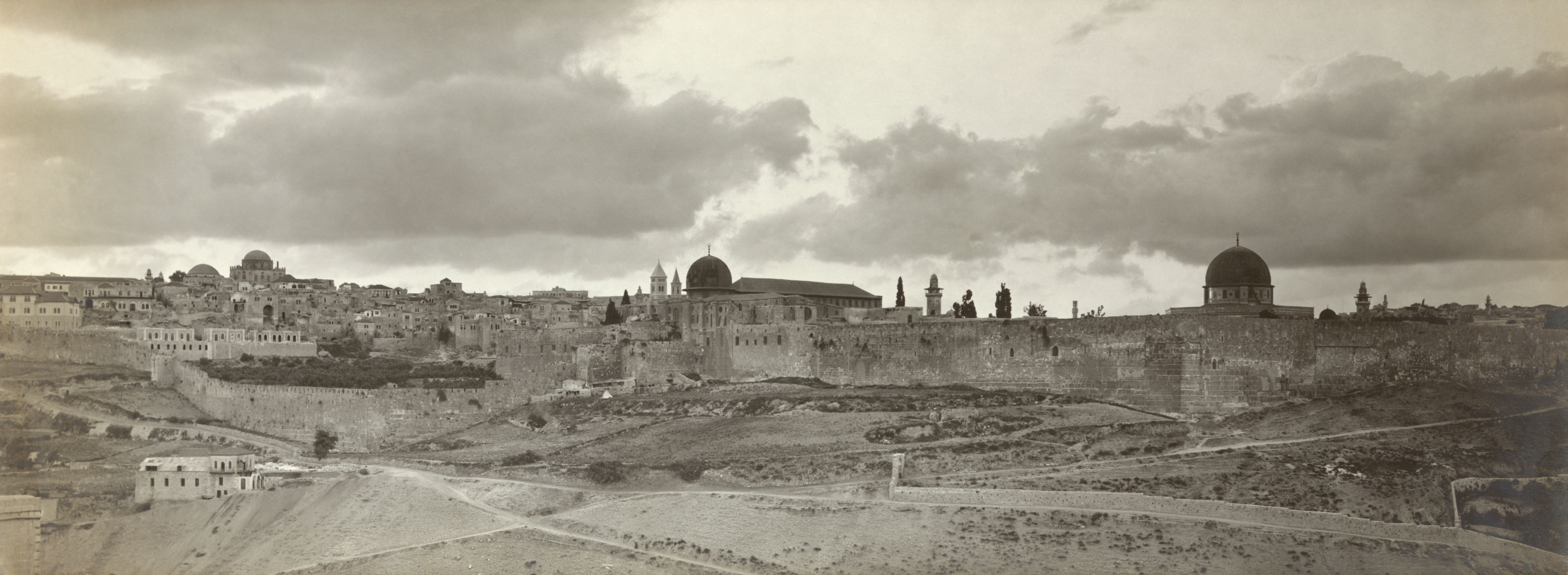
Commons is a repository for freely licensed material and, its content should be of value to the projects hosted by the Wikimedia Foundation. Of these projects, Wikipedia is the biggest and because of its encyclopaedic nature, many of the subjects are best illustrated with historical material. When you talk for instance about Jerusalem, nobody flying into Ben Gurion airport will see Jerusalem like this..
When people talk about history, it is really hard to imagine how different things were and for these reasons historically important pictures like this are so powerful. There is a wealth of detail in a picture like this, details painstakingly restored to provide us with an impression of what once was.
Wikipedia and its sister projects have a need for quality pictures like this and it is right that the restoration process will be given more attention. This portal will help to grow this community and, by giving more attention to the great work our restorers do, we will convince archives and museums to work with us and so together we will provide our audience with a better picture of what is our past.
Thanks,
GerardM
Monday, February 09, 2009
Sandro Botticelli
These are two versions of a self portrait of Sandro Botticelli. This picture was originally uploaded with a bot by Eloquence, and at some stage the picture was "enhanced". While I do agree that the original colours are a bit flat, just changing the colours does not a restoration make. There are other details to consider; the colours of the tree and the shrubs for instance do not look green any more.
Botticelli is a famous artist, it shows because the picture is used on at least 150 pages in 38 projects. When art is presented, it is not a great idea to just change the original picture "because you can". It is to be preferred when the original remains available. When improvements are made to an image, adjusting the colour levels is only one aspect of a range of actions that should be applied as a whole.
Changing an image like this may be well intended but the link with what a picture "really" looks like is lost. In my opinion it is extremely important that the changes that are made are motivated and the different phases of such a change should be available. This allows other people to collaborate on a restoration. In this way, the image is available for impovement in a wiki way.
Thanks,
GerardM
Saturday, January 31, 2009
Damaged goods
This is a stereoscopic picture of a building being built in Tel Aviv. This is the White City, in these days a world heritage site, being constructed.
When you look at this picture it is obviously damaged. For normal Wikipedia usage, steroscopic pictures are not needed. So only one frame needs to be restored. The second frame however is still valuable as it shows the parts missing in the first frame.. With some clever copy pasting, a reasonable result will be achieved.
Stereoscopic pictures are not needed for Wikipedia, but that does not mean that someone else is not interested in restoring the second frame as well. Saving the restored file in a format that is not compressed ensures that only the second frame needs to be restored. So having the intermediate files is in the interest of Open Content and Open Collaboration.
Thanks,
GerardM
Friday, January 30, 2009
Shōki is shockingly big
Shōki is a featured picture candidate on the English language Wikipedia. It is also a whopping big file, it is 53.5 Mb. When I tried to look at it, it crashed my system. This is a JPG compressed file and this file is not usable for people truly interested in assessing the quality of restored pictures. The original file is much bigger.
Of interest is that in order to show the picture, a new template had to be created because of the dimensions of this Japanese woodcut.
When you load the full sized picture from Commons, you have to wait a long time before you get an impression of the picture. At the library of Alexandria, Open Source software was demonstrated that used an algorithm that builds up the image by first giving an outline and then adds details.
PS this is a much reduced version of the unrestored image.
Thanks,
GerardM
Thursday, January 29, 2009
What is on the menu
Today I read an article about the "mouse man", a scientist who had a big influence on the research of cancer and genetics. His Wikipedia article does not have a picture.. It looks boring and this is probably because there are no appropriately licensed pictures around. There are not even pictures of laboratory mice...
Pictures illustrate, and having great illustrations make great articles a lot more accessible. When we are lucky, we can find material that is in the public domain. Museums and archives are the custodians of such material and when we are really lucky, they make quality scans available.
Many of these images are damaged and need restoration. Many of these images are restored by one of a growing group of Wikipedians. Durova is probably the most prolific restorer. It is hard to keep track of all the images she has done.
In order to reach out to other people interested in restoration work, Durova has started to upload her pictures to Flickr as well. The question is if the upload limit will allow her to upload all her work. Flickr has a slideshow so have a look..
To answer pfctdayelise, yes it would be great to have a slide show in MediaWiki as well..
Thanks,
GerardM
Monday, January 26, 2009
Looking at the larger context of restored images
These two girls are part of a recently restored picture. The detail I am interested in is the hair of these girls. This restoration was done from material available at the Library of Congress. They are part of a collection of images that were used to interest people about foreign places and foreign people. In those days people did not travel. It is pictures like this one that had the first tourists go to Marken. They are still coming.
When original material like this is restored, we share the result at Commons in a compressed format. This is great for the use on Wikipedia and for the re-use on the projects of students. For the restoration process itself it is a disaster. Restoration is a repeatable process and a restoration happens in many phases. By saving the half way products there is room for other restorers to improve on the end result.
The problem is we cannot. The files are too large. The .tiff format is not supported. Quite a lot of development effort is needed to make this happen and this is not likely to happen. So there is a need for plan B.
At Meta we make the case for a http://restoration.wikimedia.org. This project proposal will help grow the community of people who restore images. It will allow them to save the intermediate stages of their work. It will establish the Wikimedia restorations as relevant in the world of archives and musea and this will hopefully open up those organisations to collaborate with us.
Thanks,
GerardM
Thursday, January 22, 2009
The failure that is copyright
Aletta Jacobs died in 1929. As it is possible that this image is still under copyright, this picture will not be accepted in Commons. The biography of Dr Jacobs was published in 1924, clearly no longer under copyright, and it is published on the Internet under copyright by the "Digitale bibliotheek voor de Nederlandse Letteren" (dbnl). The problem is that they have the audacity to claim copyright. They claim copyright on everything they publish including work from the Middle Ages.
Copyright is a failure because important material like this picture of Aletta Jacobs are lost to us while people effectively steal the rights to her works by being bold. The dbnl does great work by making literature available on the Internet, they lose their goodwill by taking what is not theirs to take.
I found this image in the archive of the library of Congress, Durova restored it for me as a favour. I am disappointed that such unclear copyright prevents her work from making a difference.
PS this picture is a PNG.
Thanks,
GerardM
Subscribe to:
Posts (Atom)


_Borneo._TMnr_60046407.jpg)